
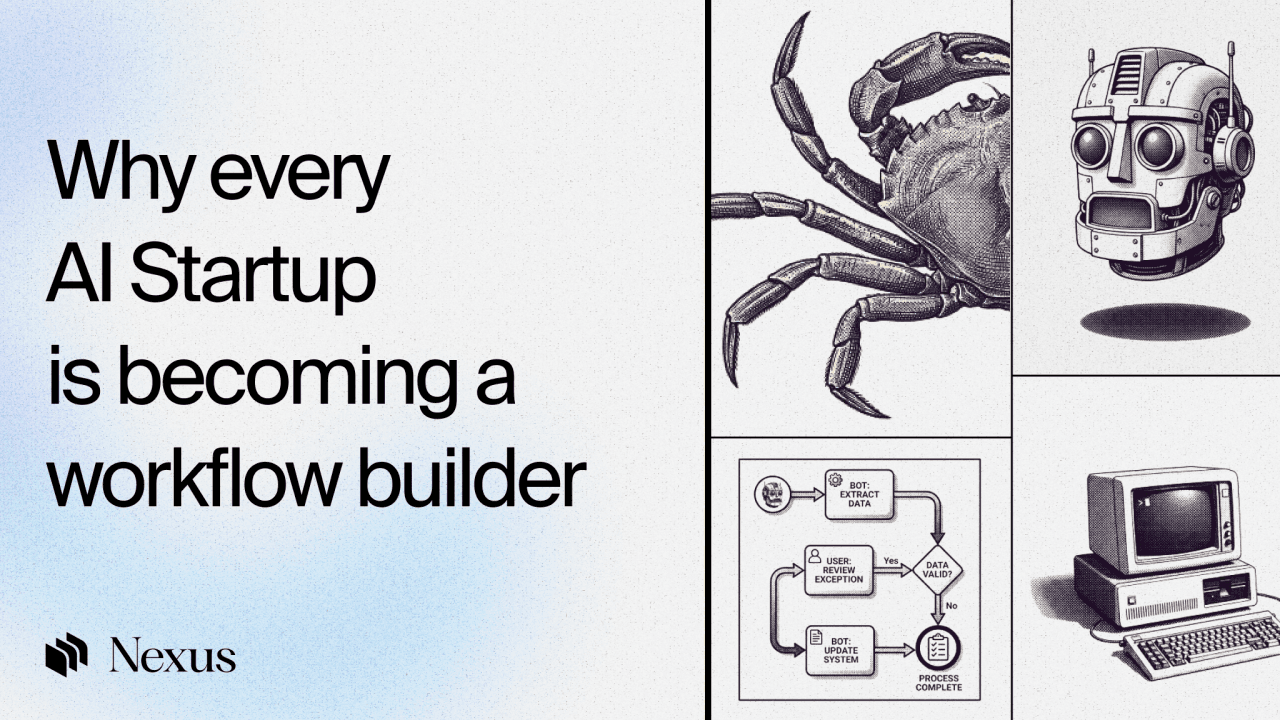
Why every AI startup becomes a workflow builder
In biology, all life evolves into crabs. in AI, all startups evolve into workflow builders. why convergence is inevitable—and why most companies are doing it wrong.
In biology, all life evolves into crabs.
In AI, all startups evolve into workflow builders.
In 1916, biologist L.A. Borradaile noticed something strange. Crustaceans kept evolving into crabs. Not once. Not twice. At least five times over 180 million years, completely unrelated species independently developed the same body plan: flat carapace, folded tail, compact form. He called this phenomenon "carcinisation"—nature's many attempts to evolve a crab.
The crab shape isn't arbitrary. It's optimal. Better protection. More efficient movement. Superior survival odds. When the environment rewards a particular form, evolution finds it repeatedly.
I'm watching the same thing happen in AI.
The optimal form problem
Every generation discovers that certain problems have optimal solutions. The environment dictates the form.
Consider transport infrastructure. In the 1830s, engineers debated track gauges, carriage designs, and propulsion methods. Decades later, the world converged on standard rail. Not because anyone mandated it. The physics of moving heavy loads efficiently simply demanded it.
Elon Musk's Boring Company promised to reinvent urban transport. Revolutionary autonomous pods. Futuristic tunnel networks. The pitch captured billions in attention and significant municipal investment.
The reality? Human drivers in regular Teslas through 12‑foot diameter tunnels. Only 8 of 68 planned miles operational. Three million passengers total since 2021. Transport professor David Levinson called it an "extremely inefficient use of expensive tunnels."
The Boring Company didn't fail because of bad engineering. It failed because it fought the optimal form. When you need to move people underground efficiently, you build a train. The solution existed for 160 years. Reinventing it wasn't innovation—it was expensive denial.
Now watch AI startups make the same mistake—but in reverse.
The evidence is everywhere
Open any AI startup's product page from 2023. You'll find chatbots. Assistants. Copilots. Natural language interfaces promising to revolutionise work through conversation.
Open the same pages today. Workflow builders. Visual canvases. Drag‑and‑drop automation. The chatbot has become a feature, not the product.
Harvey AI launched in 2022 as a legal AI assistant. Lawyers could ask questions and get research summaries. By June 2025, Harvey announced Workflow Builder—"a self‑serve tool that empowers innovation teams to build workflows from scratch." The chatbot got them in the door. Workflows kept them there.
OpenAI unveiled Agent Builder at DevDay in October 2025. Industry observers immediately compared it to n8n, Zapier, and Make. The company that defined the chatbot era now offers visual drag‑and‑drop workflow design. One reviewer described it as "like Canva for building agents."
Writer AI serves 300+ enterprises including Uber, Salesforce, and Marriott. In April 2025, they launched AI HQ with a low‑code Agent Builder. By November, they added "Playbooks" for repeatable workflows and "Routines" for scheduled automation. CEO May Habib now says: "Process mapping is the new prompt engineering."
Langdock started as an LLM‑agnostic enterprise chatbot. Their homepage now prominently features "Workflows" for automation with human‑in‑the‑loop. Merck uses it for workflow automation across departments.
Lindy AI raised $54 million positioning itself as "your first AI employee." The core product? A visual drag‑and‑drop workflow builder with 5,000+ app integrations.
Six different companies. Six different starting points. One destination.
Why convergence is inevitable
This isn't coincidence. Three forces make workflow builders the optimal form for enterprise AI.
First, reliability compounds through structure. A chatbot might give you a brilliant answer. Or a disastrous one. You won't know until you read it carefully. A workflow encodes your best process. It runs the same way every time. Enterprises don't want brilliance—they want predictability. Gartner predicts over 40% of agentic AI projects will be cancelled by 2027 due to escalating costs, unclear value, and inadequate controls. Structured workflows solve all three problems.
Second, enterprises demand control. The S&P Global 2025 survey found 42% of companies abandoned most AI initiatives—up from 17% the year before. The MIT NANDA report revealed 95% of GenAI pilots fail to deliver measurable business impact. Why? Generic AI tools don't fit specific business processes. Workflow builders let enterprises encode their expertise, their guardrails, their compliance requirements. Control isn't a limitation—it's the feature.
Third, the real promise is workforce arbitrage. Enterprises don't pay for AI to have interesting conversations. They pay to reduce headcount, accelerate processes, and cut costs. McKinsey found organisations reporting significant AI returns were twice as likely to have redesigned end‑to‑end workflows before selecting models. The value lives in process transformation, not prompt engineering.
When reliability, control, and measurable ROI all point the same direction, convergence follows.
Everyone gets it wrong
Here's where it gets interesting. Everyone is converging on workflows. But almost everyone is doing it wrong.
The agent‑first companies—Harvey, OpenAI, Writer, all of them—are bolting workflows onto chatbots. They started with AI that could converse. When enterprises demanded structure, they added visual builders as an afterthought. The architecture remains agent‑first. Workflows become a wrapper around the same unpredictable core.
This is like the Boring Company promising autonomous pods, then putting human drivers in Teslas. The form changed. The fundamental limitation didn't.
Meanwhile, the traditional automation players are making the opposite mistake.
UiPath built a $1.67 billion ARR business on robotic process automation. Zapier pioneered no‑code automation with 8,000+ integrations. Now they're racing to add AI. But how? As another block in the workflow. Another node in the canvas. The AI becomes a tool the workflow calls, not the intelligence that executes it.
This is the critical error both camps make: they treat AI and workflow as separate concerns that need connecting.
Agent‑first companies build intelligent systems, then try to make them structured.
Workflow‑first companies build structured systems, then try to make them intelligent.
Both approaches produce the same result: brittle automation that breaks when reality doesn't match the script.
What the optimal form actually looks like
The real innovation isn't adding workflows to agents. It isn't adding AI to workflows. It's reimagining what workflow execution means when intelligence is native to the system.
In traditional RPA, a workflow is a rigid sequence. Step one triggers step two triggers step three. If step two fails, the whole thing breaks. If the input varies slightly from what you scripted, the bot throws an error. This is why RPA projects have such high maintenance costs—the world changes faster than the scripts can adapt.
In agent‑first systems, you get flexibility without structure. The AI can handle variation, but you can't predict what it will do. Every execution is an experiment. Enterprises can't build reliable processes on experiments.
The optimal form puts AI at the centre of execution—not as a block that gets called, but as the engine that orchestrates. The workflow defines the process. The agent executes it intelligently. When inputs vary, the agent adapts within the boundaries the workflow sets. When edge cases emerge, the agent handles them without breaking the sequence.
This is fundamentally different from "add an AI step to your workflow" or "wrap your chatbot in a visual builder."
The difference is architectural. In bolted‑on systems, you're constantly translating between two paradigms—the rigid workflow and the flexible AI. In AI‑native execution, there's no translation. The agent understands the process. The process constrains the agent. They're the same system.
Why this matters
Gartner analysts warn that AI agents sit at the "Peak of Inflated Expectations." They note current solutions struggle with "enterprise‑contextualized decision making." Many vendors engage in "agent washing"—rebranding existing RPA and chatbots without substantial agentic capabilities.
The brutal reality: most AI startups adding workflow builders are building the 2025 equivalent of putting human drivers in autonomous vehicle tunnels. They've recognised the optimal form. They haven't actually achieved it.
And the RPA vendors adding AI blocks? They're building slightly smarter versions of the same rigid systems that required constant maintenance. The AI handles some variation, but the architecture remains fundamentally brittle.
The companies that win won't be those who converge on workflows fastest. They'll be those who build AI‑native execution from the foundation—where intelligence isn't a feature you add, but the core of how work gets done.
The uncomfortable truth
At Nexus, we've watched the entire industry wrestle with this convergence. And we've bet everything on a specific answer.
Yes, the optimal form is a workflow builder. But not an RPA with a bolted‑on AI agent. Not an open‑ended agent that occasionally calls an RPA. The answer is a workflow builder with AI agent capabilities woven throughout its execution.
Every step in the workflow should be intelligent. Every decision point should adapt. Every handoff should understand context. The agent isn't a block you drag onto the canvas—it's the fabric the canvas is made of.
This is what we built at Nexus. Not because we predicted the convergence. Because we started from the right question: how do you give business teams the reliability of structured workflows and the flexibility of AI agents at the same time?
The answer wasn't "build an agent, add workflows later." It wasn't "build workflows, add AI blocks later." It was "build workflows where every block thinks."
When Orange Belgium needed to automate customer onboarding, they didn't want a chatbot that might work. They didn't want rigid RPA that breaks when inputs vary. They wanted a process they could trust that adapts intelligently. A non‑technical team member built it. It now generates €4M+ monthly with 50% conversion improvements.
That's not an agent. That's not RPA. That's workflow automation reimagined for the AI era.
Carcinisation happens because the crab form is optimal. The entire AI industry is evolving toward workflow builders. But evolving the shell isn't enough. The companies that win will be those that evolved the right architecture from day one—where intelligence isn't a feature you add, but how every workflow executes.
The crabs are coming. We've been one all along.
What patterns are you seeing in AI convergence? I'd love to hear your perspective in the comments.
Your next
step is clear
The only enterprise platform where business teams transform their workflows into autonomous agents in days, not months.