
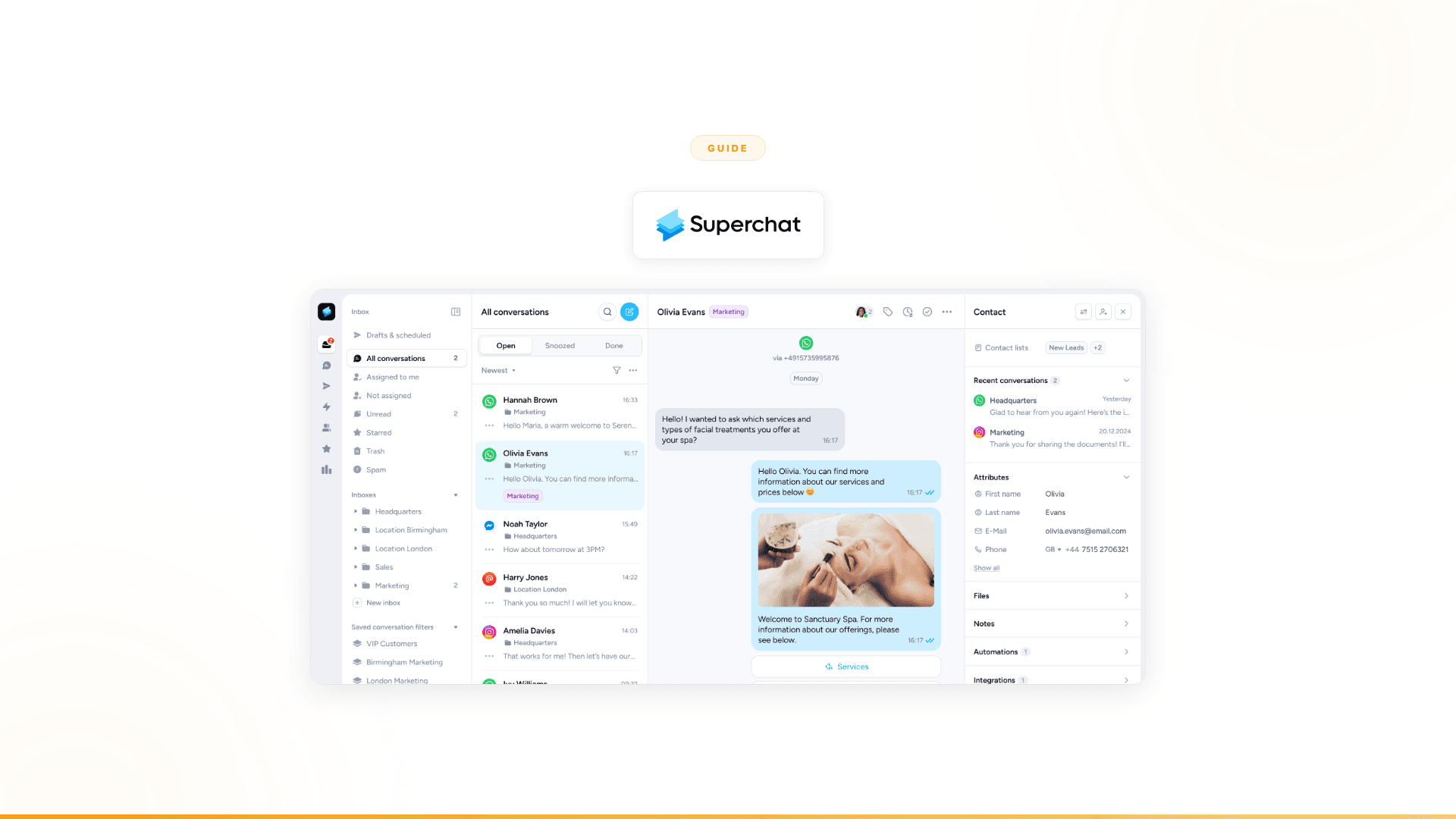
WhatsApp Business vs AI Agents for Telecom (2026)
WhatsApp platforms handle the messaging channel. For telecom operators, that is 10% of the work. Here is the 12-step breakdown and what each approach delivers.
A telecom operator evaluating WhatsApp Business platforms is solving a real problem. Customers want to reach you on WhatsApp. You need a way to manage those conversations at scale. Platforms like Superchat, Trengo, and Respond.io exist to do exactly that: route messages to a shared inbox, let agents respond from one interface, and bolt on a chatbot for common questions.
That evaluation makes sense. But it addresses roughly 10% of what happens when a telecom customer sends a message.
Here is the other 90%. Walk through a single plan change request, step by step, and count which steps a WhatsApp Business platform handles and which it does not. The gap explains why telecom operators who deploy these platforms report better CSAT scores but no meaningful reduction in operational cost. The customers like the new channel. The work behind it stays the same.
The 12 steps behind a single WhatsApp message
A customer sends "I want to upgrade my plan" on WhatsApp. From their side, this is a simple request. From the operator's side, here is what needs to happen before that request is complete.
Step 1: Channel reception. The message arrives via the WhatsApp Business API. The platform routes it to the right queue based on keywords, language, or business unit.
Step 2: Customer identification. The system matches the phone number to a customer account. This requires a lookup in the CRM, which may or may not have the WhatsApp number associated with the correct record. If the number is shared, prepaid, or recently ported, matching gets complicated.
Step 3: Identity verification. Regulatory requirements vary by market. Some jurisdictions require security questions. Others require PIN validation. Some require document verification for certain plan types. The verification method depends on the market, the request type, and the customer segment.
Step 4: Current plan retrieval. Pull the customer's active plan details, contract terms, remaining commitment period, current monthly charges, and any active add-ons from the billing support system (BSS). If the operator runs multiple BSS instances across markets or legacy acquisitions, this may require querying more than one system.
Step 5: Eligibility check. Cross-reference the customer's account status, payment history, outstanding balance, and contract terms against upgrade eligibility rules. These rules differ by market, by plan type, by customer segment, and sometimes by promotional period. A customer who is 3 months into a 24-month contract has different options than one who is 22 months in.
Step 6: Available options. Retrieve eligible upgrade paths from the product catalog. Filter based on eligibility output, current plan type, and any active promotions. Calculate the price difference for each option, including prorated charges for the current billing cycle.
Step 7: Regulatory compliance. Depending on the market, specific disclosures must be presented before a plan change can proceed. Cooling-off period information in the EU. Terms and conditions in specific formats. Data processing consent where GDPR applies. Each jurisdiction has different requirements, and the operator is liable for compliance regardless of how the interaction was initiated.
Step 8: Customer decision. Present the filtered options to the customer, explain the price differences and terms, and get explicit confirmation to proceed.
Step 9: Plan modification. Execute the change in the billing system. Update the account record. Adjust prorated charges. Depending on the plan type, this touches the BSS, the provisioning system, and the CRM, potentially in sequence with dependencies between them.
Step 10: Network provisioning. If the upgrade involves a service change (higher data cap, different speed tier, added features like international roaming), the network provisioning system needs to activate the new configuration on the customer's line.
Step 11: Confirmation and documentation. Send the customer a confirmation with new plan details, updated charges, effective date, and applicable terms. Log the entire interaction with timestamps, decisions made, and disclosures presented. This audit trail is a regulatory requirement in most European markets.
Step 12: Post-change verification. Confirm the plan change propagated correctly across all systems. Flag any discrepancies between the BSS record, the provisioning state, and the CRM record for manual review.
Where WhatsApp platforms stop
A WhatsApp Business platform like Superchat, Trengo, or Respond.io handles Step 1 and Step 8. It receives the message and provides the interface where the conversation happens. Some platforms add basic chatbot functionality for initial greetings and FAQ responses. A few offer template-based flows that guide a customer through a scripted question sequence.
Steps 2 through 7, and Steps 9 through 12, sit outside what these platforms do. Those steps require live connections to the BSS, CRM, product catalog, compliance rules engine, provisioning system, and regulatory database. WhatsApp Business platforms were not designed to connect to these systems at execution depth. They were designed to manage conversations.
The result is predictable. A human agent handles the WhatsApp conversation using the platform, then switches to 4 to 6 different backend systems to complete the actual work. The platform made the conversation easier to manage. It did not reduce the operational work behind it.
This is the same architectural distinction between conversational AI and agentic AI that applies across industries. But in telecom, the gap is wider because the backend systems are more numerous, the compliance requirements are stricter, and the process steps are more interdependent.
The 10/90 math
Telecom operators consistently find that the conversation layer (Steps 1 and 8) represents roughly 10% of the total time and cost involved in resolving a customer interaction. The other 90% is backend work: system lookups, eligibility validation, compliance checks, cross-system updates, provisioning, and documentation.
When you deploy a WhatsApp platform that optimizes the 10%, you get a better messaging experience. Customers prefer WhatsApp over calling a contact center. CSAT scores improve. But your cost-per-interaction barely moves because the 90% is untouched.
This explains a pattern that telecom CX leaders describe repeatedly: the WhatsApp channel launch was a success by engagement metrics, but it did not deliver the operational efficiency that justified the business case.
The channel was never the bottleneck. The work behind the channel was.
Architecture comparison: WhatsApp Business platforms vs AI agents
| Dimension | WhatsApp Business Platforms | AI Agent Platforms |
|---|---|---|
| Core design | Built around the message. Data model: conversations, contacts, channels, inboxes. | Built around the work. Data model: workflows, system connections, business rules, actions. |
| Conversation handling | Shared inbox with routing, assignment, and chatbot for FAQs. Handles the dialogue. | Conversation is one input/output surface. The agent handles dialogue and the workflow behind it. |
| Backend integration | Channel connectors (WhatsApp, Instagram, email). Backend connections via Zapier/Make for notifications and simple data sync. | Native integrations with BSS, CRM, provisioning, compliance systems. Read and write access in real time during the interaction. |
| Compliance | GDPR compliance for the messaging layer. No audit trails for operational decisions. | Full decision traceability. Audit logs for every step. Compliance disclosures presented programmatically per jurisdiction. |
| Multi-market operations | Multilingual chat responses. No market-specific regulatory logic or cross-market data harmonization. | Market-specific business rules, compliance requirements, and product catalogs handled natively across jurisdictions. |
| Autonomous resolution | Chatbot resolves FAQ-level queries. Anything requiring backend action routes to a human. | Agent resolves end-to-end: identify, verify, check eligibility, present options, execute change, provision, confirm, log. |
| Deployment model | Self-serve SaaS. Minutes to connect WhatsApp. Hours to configure chatbot flows. | 3-month POC with Forward Deployed Engineers. Production agents in days to weeks. Integration with legacy telecom infrastructure included. |
| Scale | Designed for SMBs handling thousands of conversations. Superchat's largest documented deployment: 5,000 daily inquiries. | Designed for operators handling millions of interactions across multiple markets. |
| Security certifications | GDPR. | SOC 2 Type II, ISO 27001, ISO 42001, GDPR, EU AI Act ready. |
| Pricing | EUR 79-249/month plus add-ons. Per-user, per-channel, per-bot pricing. | Per-agent, tied to value delivered. Not tied to conversation volume. |
What each approach actually delivers
WhatsApp Business platforms deliver a better messaging channel. Customers reach you on WhatsApp instead of calling a contact center. Conversations are organized in a shared inbox instead of scattered across individual phones. A chatbot handles the first 20 seconds of greeting and FAQ deflection. Your support team sees messages faster.
This is genuinely valuable if your problem is channel fragmentation. If your team manages WhatsApp from personal phones, if customers can not reach you on their preferred messaging app, if you have no central record of WhatsApp conversations, these platforms solve that.
AI agents deliver operational workflow completion. When a customer sends "I want to upgrade my plan," the agent handles all 12 steps: identification, verification, plan retrieval, eligibility check, option filtering, compliance disclosure, customer decision, plan modification, provisioning, confirmation, logging, and verification. The WhatsApp conversation is the interface. The completed workflow is the product.
The architectural difference is not a feature gap. It is a category gap. A WhatsApp platform with more features does not become an agent platform, just as a spreadsheet with more formulas does not become a database. The underlying data model, integration architecture, and execution model are different.
For a deeper breakdown of this category distinction, see Conversational AI vs Agentic AI: the architecture shift.
What this looks like in telecom production
Orange Group: from 27% drop-out to $6M+ yearly revenue
Orange is a multi-billion euro telecom operator with 120,000+ employees across Europe and Africa. They operated a CX chatbot platform that handled the conversation layer on WhatsApp and web. It could greet customers, understand basic intents, and route to human agents. It had a 27% drop-out rate. Customers started conversations but abandoned them because the bot could not complete their actual request.
The problem was not the conversation quality. The problem was that the chatbot could talk but could not do the work. It could not validate eligibility against the billing system. It could not run compliance checks. It could not execute the actual onboarding process.
Nexus agents replaced that platform and now complete customer onboarding end-to-end. The agent handles the full workflow: verification, eligibility, plan setup, billing, regulatory compliance, and confirmation. Deployed in 4 weeks. Built by the business team, not engineering.
Results:
- 50% conversion improvement (from 27% drop-out to autonomous completion)
- $6M+ incremental yearly revenue
- 90% autonomous resolution rate
- 100% team adoption
- Full compliance: every step visible, every decision logged
Customers still use WhatsApp. The difference is that the agent completes the work behind the WhatsApp message instead of routing it to a human who then navigates 6 backend systems manually.
European telecom (13,000+ employees): 40% of support capacity freed
A major European telecom operator tried to solve this problem before. They spent 6 months building with Copilot Studio. It did not work. The tooling could handle simple conversation flows but broke on the operational complexity behind them.
With Nexus, they built a dozen production agents in 12 weeks covering support, compliance, registration, data harmonization, and escalation routing. Not just FAQ automation on WhatsApp. A coordinated system of agents working across different telecom functions, each connected to the backend systems required for its domain.
Results:
- 40% of support capacity freed across millions of interactions
- Full regulatory compliance maintained
- Complete audit trails for every decision
- 12-week deployment from start to production
When a WhatsApp Business platform is enough
WhatsApp Business platforms are the right tool in specific scenarios, and it is worth being clear about when they work well.
Your interactions are primarily informational. If most customer messages are about store hours, coverage maps, plan pricing, or basic FAQ, the conversation is the work. There is no complex backend workflow behind it. A chatbot on a WhatsApp platform handles this effectively.
You use WhatsApp primarily for outbound marketing. Broadcasts, promotional campaigns, appointment reminders, review collection. WhatsApp Business platforms handle outbound messaging well, and the open rates (80-90% for WhatsApp campaigns) are significantly higher than email. For SMB-focused use cases like these, platforms like Superchat deliver real value.
You are a small telecom reseller, not an operator. A local Vodafone franchise, a phone repair shop, or a regional MVNO with hundreds of customers. A shared inbox with a basic chatbot at EUR 79/month covers what you need. You do not have the backend system complexity that makes the 10/90 split painful.
Your support team is under 20 people and handles under 1,000 conversations per day. At this scale, the operational savings from workflow automation may not justify the integration investment. A WhatsApp platform that organizes your team's conversations is the practical choice.
When you need agents
The mismatch between WhatsApp platforms and telecom operations becomes clear when you map your top 10 customer interaction types. For each one, count the backend systems involved and the manual steps required after the conversation starts.
If most of your interactions involve 3 or more systems and 5 or more manual steps, a WhatsApp platform optimizes the wrong layer. Plan changes, onboarding, billing disputes, SIM swaps, service migrations, compliance-related requests, technical support with provisioning changes: these are the interactions that define telecom support costs, and every one of them requires backend execution that WhatsApp platforms do not reach.
The question is not whether your customers should reach you on WhatsApp. They should. WhatsApp is the preferred messaging channel in most European and African markets. The question is whether the platform behind that channel handles only the message or also completes the work the message initiates.
For telecom operators, the channel is the beginning of the problem. The work behind it is the other 90%.
Worth exploring?
Every Nexus engagement starts with a 3-month proof of concept tied to measurable outcomes. Forward Deployed Engineers embed with your team from day one. You see the results before committing. You can exit anytime.
100% of clients who started a POC converted to an annual contract. Every one.
See how Nexus agents handle telecom operations end-to-end -->
Related reading
Your next
step is clear
The only enterprise platform where business teams transform their workflows into autonomous agents in days, not months.