
Top 10 AI Tools for Multilingual Customer Support in 2026
Translation is solved. The hard part is completing workflows across markets and languages. Here are 10 AI tools for multilingual customer support, ranked by what they deliver beyond the conversation layer.
Translation is no longer the hard part.
In 2024, multilingual customer support meant building chatbots that could understand and respond in multiple languages. That was the challenge. NLU models needed language-specific training. Intent libraries had to be duplicated and localized. The technology gap was real, and platforms like Yellow.ai, Kore.ai, and others closed it well.
By 2026, that gap is closed. Large language models handle translation natively. Most enterprise AI platforms support 50+ languages out of the box. Building a chatbot that converses in French, Japanese, or Arabic isn't a differentiator. It's table stakes.
The real challenge has shifted. And most enterprises have felt the shift firsthand.
The hard part isn't getting your AI to speak the customer's language. It's getting your AI to complete the work behind the customer's conversation, in every market, with every market's regulatory requirements, system configurations, and process variations. A chatbot that answers a question in Portuguese is useful. An agent that completes the entire onboarding workflow in Brazil, validating data against local regulations, checking compatibility with local systems, routing exceptions to the right team, executing actions across CRM and billing platforms, that's the difference between a language feature and a multilingual operation.
Here are 10 tools for multilingual customer support in 2026, ranked by what they deliver beyond the conversation layer.
Quick comparison
| Tool | Category | Languages | Best for | Goes beyond conversation? |
|---|---|---|---|---|
| Nexus | Autonomous agent platform | 95+ | Full workflow automation across markets | Yes, completes end-to-end workflows |
| Yellow.ai | Conversational AI | 135+ | Multilingual CX conversations at scale | No, conversation layer only |
| Kore.ai | Conversational AI | 120+ | Enterprise chatbots with deep NLU | No, conversation layer only |
| Ada | AI customer service | 50+ | Automated resolution for support | Partial, resolution-focused |
| Cognigy | Conversational AI | 100+ | European contact center automation | No, conversation layer only |
| Sprinklr | Unified CXM | 100+ | Omnichannel CX management | No, CX layer only |
| Intercom (Fin AI) | Customer messaging | 45+ | Mid-market customer support | No, conversation layer only |
| Freshdesk (Freddy AI) | Customer support suite | 40+ | Freshworks ecosystem support teams | No, ticketing layer only |
| Zendesk AI | Customer support suite | 30+ | Zendesk ecosystem support teams | No, ticketing layer only |
| Google Cloud CCAI | Contact center AI | 100+ | Google Cloud enterprise contact centers | No, contact center layer only |
The tools, ranked
1. Nexus
What it is: An autonomous agent platform paired with Forward Deployed Engineers who embed with your team. Nexus agents operate in 95+ languages, but the language coverage isn't the point. The point is what those agents do: they complete entire business workflows across markets, not just conversations. Collect data. Validate against local regulations. Make decisions. Handle exceptions. Execute actions across CRM, ERP, billing, and internal platforms. Any department. Any market. Business teams build and own the agents.
Why it's first on this list:
Every other tool on this list automates the conversation layer in multiple languages. That's the 10%. Nexus automates the 90% behind it. The distinction matters most for multilingual operations because the 90% varies by market. Regulatory requirements differ. System configurations differ. Compliance rules differ. Process flows differ. A chatbot that speaks 135 languages handles the language variation. An agent that completes workflows across markets handles the operational variation. That's the hard part.
What it looks like in production:
- Orange Group (multi-billion euro telecom, 120,000+ employees): Business team built autonomous customer onboarding agents deployed across multiple European markets and languages. Not just conversations in those languages. Complete onboarding workflows: data validation, compatibility checks, exception routing, cross-system execution. 50% conversion improvement. ~$6M+ yearly revenue. 4-week deployment. 90% autonomous resolution. 100% team adoption. Their previous CX chatbot had a 27% drop-out rate.
- Lambda ($4B+ AI infrastructure company): Sales intelligence agents monitoring 12,000+ accounts autonomously. $4B+ pipeline discovered. 24,000+ hours of research capacity added annually. Built by a non-engineer.
- European telecom (13,000+ employees): Agents across support, compliance, registration, and data harmonization. 40% of support volume freed across millions of interactions. Full regulatory compliance maintained.
How it handles multilingual:
Nexus agents don't just translate. They adapt entire workflows by market. Orange's agents in France follow French regulatory requirements. The same agents in a different European market follow that market's requirements. The conversation language changes. The validation rules change. The compliance checks change. The system integrations change. One platform handles all of it.
Pricing: Per-agent, tied to value delivered. Not per-conversation or per-market. An agent serving customers across 10 markets costs the same as one serving a single market.
Best for: Enterprises operating across multiple markets that need AI to complete workflows end-to-end in every market, not just converse in every language.
Full Nexus vs Yellow.ai comparison -->
2. Yellow.ai
What it is: Conversational AI platform built for multilingual CX and EX automation. 135+ languages. 35+ channels. Strong NLU with localization beyond simple translation. Handles customer support conversations, HR helpdesk queries, and IT self-service. Over 1,300 enterprise customers including Sony, Hyundai, and Domino's. Deep APAC market expertise.
Strengths: The broadest language coverage in the conversational AI category. Yellow.ai doesn't just translate. Its NLU models understand cultural nuance, regional dialects, and context-specific intent in ways that generic translation can't match. For enterprises with heavy APAC presence, Yellow.ai understands local channel preferences (WhatsApp, LINE, WeChat) and regional interaction patterns.
Limitation: The structural ceiling is the conversation. Yellow.ai automates what the customer says and how the bot responds, across 135+ languages. What happens after the conversation, the operational work of fulfilling, validating, routing, and executing, still requires humans. Broad language coverage on the dialogue layer. Same gap on the workflow layer.
Pricing: Usage-based and enterprise licensing, tied to conversation volume and channels.
Best for: Enterprises where multilingual conversation automation is the primary need, particularly in APAC markets, and where the work behind conversations is already handled by existing systems and teams.
See Yellow.ai alternatives -->
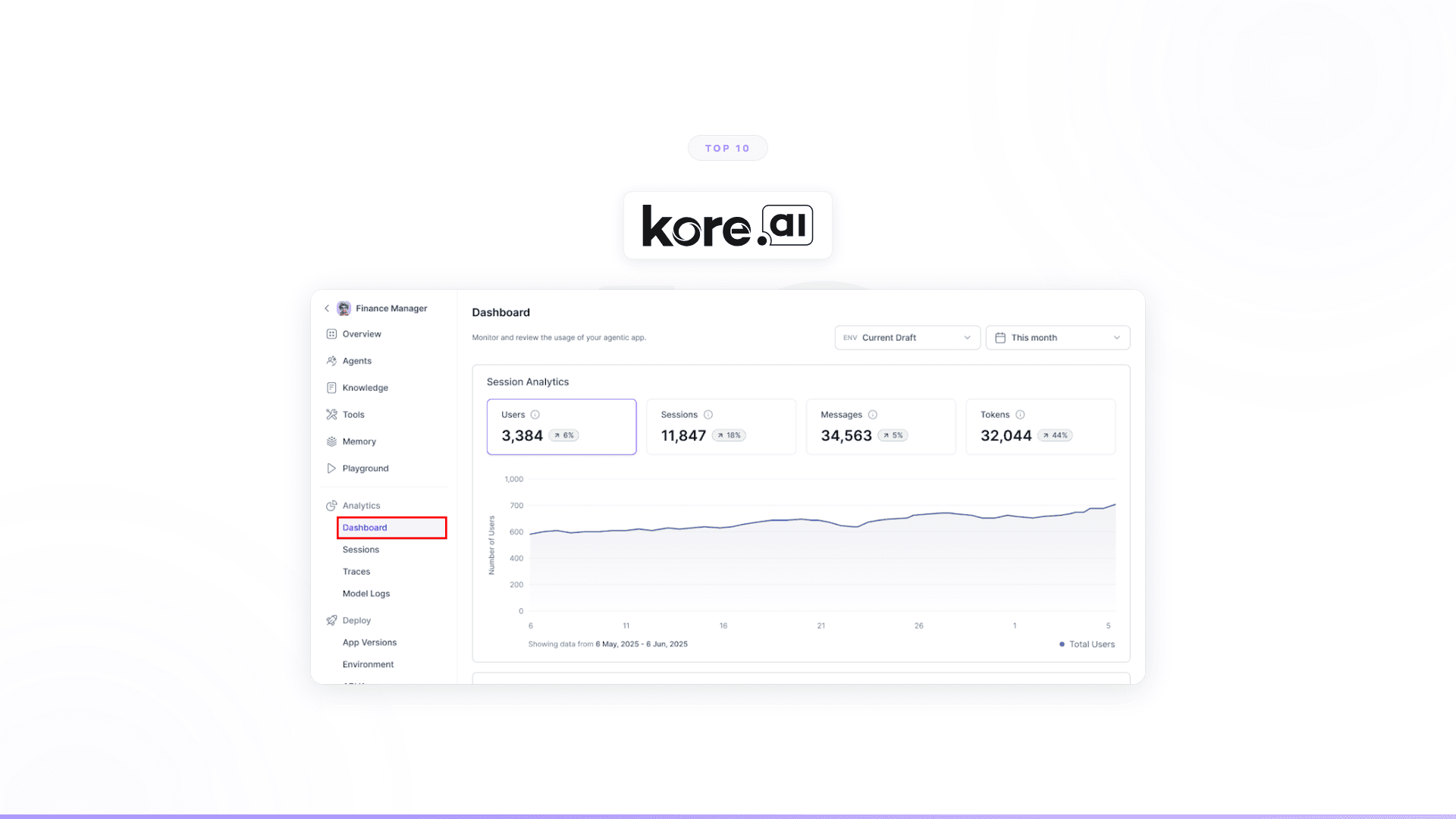
3. Kore.ai
What it is: Enterprise conversational AI platform. 120+ languages. Gartner Magic Quadrant Leader. Strong NLU engine with no-code/low-code dialog building. Handles customer support, IT helpdesk, and HR automation. More North American and European enterprise presence compared to Yellow.ai's APAC strength.
Strengths: Deep NLU for complex dialog flows. Good at handling multi-turn enterprise conversations where intent isn't straightforward. Enterprise governance and security features are mature.
Limitation: Same category as Yellow.ai, same ceiling. Kore.ai automates conversations well across 120+ languages. The work behind those conversations remains outside the platform's scope. Different vendor, same structural limitation.
Pricing: Enterprise licensing, typically $300K+ annually for large deployments.
Best for: Enterprises that need enterprise-grade conversational AI with strong NLU and prefer a vendor with deeper North American/European presence than Yellow.ai.
Full Nexus vs Kore.ai comparison -->
4. Ada
What it is: AI customer service platform focused on automated resolution. Measures success by customer issues fully resolved, not just conversations handled. 50+ languages. Clean product design. Strong in SaaS and technology companies.
Strengths: The resolution-first philosophy is the right instinct. Ada tracks whether the customer's problem was actually solved, not just whether the bot responded. This leads to better outcomes for straightforward support use cases.
Limitation: Narrower language coverage than Yellow.ai or Kore.ai (50+ vs 135+ or 120+). Resolution focus is still scoped to the conversation. Ada resolves the customer's question, but the operational workflow that question triggers, the account update, the compliance check, the cross-system execution, sits outside the platform.
Pricing: Usage-based, tied to automated resolutions.
Best for: Technology and SaaS companies that prioritize resolution rates over raw language coverage, and whose multilingual needs fit within 50 languages.
5. Cognigy
What it is: Conversational AI and contact center automation platform. Based in Germany. Strong in European enterprise markets. 100+ languages. Deep integrations with Genesys, NICE, and other CCaaS platforms. Voice-first architecture for contact center use cases.
Strengths: If your contact center runs on Genesys or NICE, Cognigy integrates natively. The voice capabilities are strong. European data residency and GDPR compliance are built in, which matters for European enterprises with strict data sovereignty requirements.
Limitation: Scoped to contact center conversations. The agents that answer calls and chat messages are multilingual. The processes behind those interactions, the order fulfillment, compliance verification, cross-system coordination, remain manual or require separate tools.
Pricing: Enterprise licensing, tied to interaction volume and channels.
Best for: European enterprises with Genesys or NICE contact centers that need multilingual voice and chat automation with European data residency.
6. Sprinklr
What it is: Unified customer experience management platform. Social media management, customer service, marketing, and engagement across 30+ digital channels. 100+ languages. AI-powered across the suite but primarily a CXM platform, not a pure conversational AI tool.
Strengths: The unified view. If you need to manage social listening, community engagement, customer service, and marketing campaigns across markets and languages from a single platform, Sprinklr covers that breadth. The AI features span the entire CX suite, not just the conversation layer.
Limitation: Breadth over depth on conversational AI specifically. Sprinklr's chatbot capabilities aren't as deep as Yellow.ai's or Kore.ai's. And the platform's scope, while broad across CX, still covers the customer interaction layer. The operational work behind those interactions stays outside.
Pricing: Per-user, enterprise pricing. Known for being expensive ($300K+ annually).
Best for: Large enterprises that need a unified CX platform across social, messaging, and service channels, where multilingual AI is one feature within a broader strategy.
7. Intercom (Fin AI)
What it is: Customer messaging platform with AI-powered support resolution. Fin AI answers customer questions using your help center content and conversation history. Modern product design. 45+ languages. Strong in SaaS, technology, and mid-market companies.
Strengths: Clean product experience. Fin AI is effective at resolving common support questions from knowledge base content. For product-led companies with self-serve customers, the integration between in-app messaging, help center, and AI resolution is well-designed.
Limitation: 45 languages is adequate for many businesses but significantly narrower than Yellow.ai (135+) or Kore.ai (120+). Enterprise governance and compliance features are less mature. Still limited to the conversation and resolution layer.
Pricing: Per-seat starting around $39/month. AI resolution pricing on top.
Best for: Mid-market SaaS and technology companies that need modern customer messaging with AI resolution and whose multilingual needs are moderate.
8. Freshdesk (Freddy AI)
What it is: Customer support platform from Freshworks with AI-powered features. Ticket routing, auto-responses, knowledge suggestions, basic chatbot. Part of the broader Freshworks suite. 40+ languages.
Strengths: If your team is already on Freshworks, Freddy AI is the path of least resistance. Integrated into your existing ticketing, CRM, and support workflows. No separate platform to manage.
Limitation: AI capabilities are a feature within a support platform, not a standalone conversational AI system. Language coverage (40+) is narrower. NLU depth doesn't match Yellow.ai, Kore.ai, or Ada. The AI helps with ticketing. It doesn't complete workflows.
Pricing: Per-agent seat, $15-95/agent/month depending on tier.
Best for: Support teams on Freshworks that want built-in AI without adding a separate conversational AI platform.
9. Zendesk AI
What it is: Customer support platform with AI-powered automation. Similar to Freshdesk but in the Zendesk ecosystem. AI agents handle common customer requests, route tickets, suggest responses. 30+ languages. Part of the broader Zendesk suite.
Strengths: If you're on Zendesk, the AI features are native. Strong integration with Zendesk's ticketing, knowledge base, and analytics. Reliable enterprise platform with large install base.
Limitation: Similar to Freshdesk. The AI is a feature within a support platform. Language coverage (30+) is the narrowest of the major enterprise tools on this list. Conversational AI depth doesn't match purpose-built platforms. Limited to the support ticketing layer.
Pricing: Per-agent seat, $55-115/agent/month depending on tier. AI add-on pricing on top.
Best for: Support teams on Zendesk that want native AI features and whose multilingual needs are limited to 30 languages.
10. Google Cloud Contact Center AI
What it is: Google's contact center AI platform. Virtual agents for customer self-service. Agent Assist for helping human agents during calls. Insights for analyzing conversations. Built on Google's Dialogflow CX and leverages Google's language models. 100+ languages through Google's translation infrastructure.
Strengths: Google's language models and translation technology are world-class. The infrastructure is solid. For enterprises already on Google Cloud, CCAI integrates natively. Agent Assist (real-time suggestions during human agent calls) is a capability that most pure chatbot platforms don't offer.
Limitation: It's a building block, not a solution. CCAI requires significant integration work to deploy in production. You need engineering resources to build, configure, and maintain the virtual agents. And it's scoped to the contact center. The operational workflows behind contact center conversations stay outside the platform's reach.
Pricing: Usage-based (per-session, per-interaction). Custom enterprise pricing through Google Cloud.
Best for: Google Cloud enterprises with engineering resources that need multilingual contact center AI and are willing to invest in custom implementation.
The real question for 2026
The list above covers the major players. But the question that matters isn't "which tool handles the most languages?" Translation and multilingual conversation are solved problems. Every tool on this list handles them, with varying depth.
The question is: what happens after the conversation?
A customer in Germany asks about their onboarding status. A customer in Brazil needs to change their plan. A customer in Japan reports a service issue. All three conversations can be automated in the local language by any competent platform on this list.
But the work behind those conversations is different in each market. German regulatory requirements differ from Brazilian ones. The system configurations in Japan don't match the ones in Germany. The compliance rules change. The escalation paths change. The integrations change.
If your bottleneck is the conversation, any of the top 5 platforms on this list will serve you well. Yellow.ai and Kore.ai for maximum language coverage. Ada for resolution focus. Cognigy for European voice. Sprinklr for unified CX.
If your bottleneck is the work behind the conversation, and it varies by market, with different regulations, systems, and processes in each country you operate in, you need AI that completes workflows across markets. Not just conversations across languages.
That's the line between a multilingual chatbot and a multilingual operation.
What multilingual workflow completion looks like
Orange Group is the clearest example. They operate across multiple European countries and languages. Their challenge wasn't customer conversations. They had a CX chatbot for that. It had a 27% drop-out rate, but it handled conversations.
Their challenge was the work behind those conversations. Customer onboarding in each market involved different data validation requirements, different system integrations, different compliance checks, different exception handling. A chatbot in French and a chatbot in Portuguese both answered questions. Neither completed the onboarding workflow.
They built autonomous onboarding agents on Nexus. Not chatbots. Agents that complete the entire workflow: collect data, validate against market-specific rules, check compatibility, route exceptions, execute across CRM and billing platforms. Deployed across multiple European markets in 4 weeks. 50% conversion improvement. ~$6M+ yearly revenue. 90% autonomous resolution. 100% team adoption.
The conversation language was one variable. The workflow, with all its market-specific complexity, was the actual problem. The agents handle both.
Worth exploring?
If multilingual conversations aren't your bottleneck anymore, and the real challenge is completing multilingual workflows that span systems, markets, and regulatory requirements, it might be worth seeing what Orange achieved across European markets, or how Lambda built sales intelligence that monitors 12,000+ accounts autonomously.
Every Nexus engagement starts with a 3-month proof of concept tied to measurable outcomes. Forward Deployed Engineers embed with your team from day one. You see the results before committing. You can exit anytime.
100% of clients who started a POC converted to an annual contract. Every one.
See how Nexus compares to Yellow.ai -->
Related reading
Your next
step is clear
The only enterprise platform where business teams transform their workflows into autonomous agents in days, not months.