
Top 10 Sprinklr Alternatives for Customer Experience in 2026
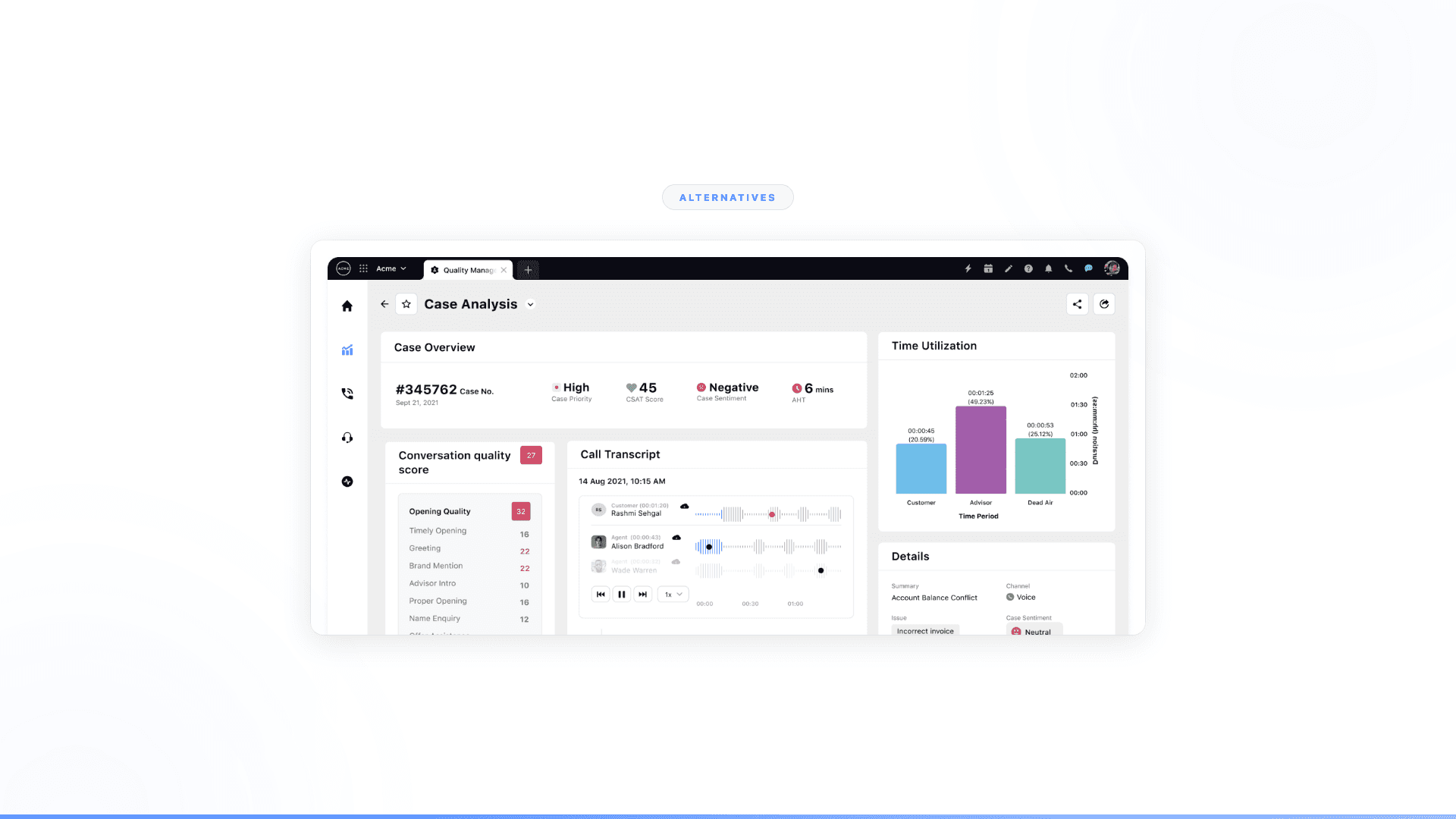
Sprinklr automates conversations across 30+ channels. But conversations are only 10% of CX. Here are 10 alternatives ranked by whether they complete the work behind the conversation.
Sprinklr isn't the problem. It does what it was built to do. It unifies 30+ channels into a single pane of glass, it automates customer conversations, and it gives contact center teams a clear view of what's happening across voice, chat, social, and email. Umniah reduced agent handover by 53% using it. That's real.
The problem is what Sprinklr wasn't built to do. And that's where most enterprises hit the wall.
When a customer says "I want to switch my plan," the conversation is the easy part. Someone still has to check eligibility against the billing system, validate the account in the CRM, calculate proration, flag compliance issues, route approvals, execute the change, and confirm. That's seven or eight steps that happen after the conversation. Sprinklr handles the first one. The other seven stay manual.
If you're evaluating Sprinklr alternatives because your CX still depends on humans for everything behind the conversation, you're not alone. Most enterprises that search for alternatives aren't looking for a better conversation tool. They're looking for something that completes the work the conversation starts.
Here are 10 alternatives worth evaluating, organized by what they actually do.
Quick comparison
| Tool | Category | Best for | Completes work behind conversation? | Pricing model |
|---|---|---|---|---|
| Nexus | Autonomous agent platform | Full workflow completion across CX and operations | Yes, end-to-end | Per-agent |
| Genesys Cloud CX | Contact center platform | Omnichannel contact center operations | No, conversation layer only | Per-user/concurrent |
| NICE CXone | Contact center platform | Large-scale contact center workforce management | No, conversation layer only | Per-seat |
| Salesforce Service Cloud | CRM + service platform | Service management within Salesforce ecosystem | Partial (within CRM) | Per-user ($150+/mo) |
| Zendesk | Customer support platform | SMB and mid-market support ticketing | No | Per-agent ($55+/mo) |
| Intercom | Conversational support platform | Product-led support with AI chatbot | Conversations only | Per-seat ($39+/mo) |
| Freshdesk | Customer support platform | Budget-conscious support automation | No | Per-agent ($15+/mo) |
| Qualtrics | Experience management platform | Measuring CX, not automating it | No (measurement only) | Enterprise license |
| Medallia | Experience management platform | Real-time customer feedback at scale | No (measurement only) | Enterprise license |
| Custom build | Internal development | Engineering teams building from scratch | Depends on team | Engineering cost |
The alternatives, ranked
1. Nexus
What it is: An autonomous agent platform with Forward Deployed Engineers who embed with your team. Nexus agents don't just automate conversations. They complete entire business workflows end-to-end: collecting data from multiple systems, validating it, making decisions within guardrails, handling exceptions, executing actions, and escalating with full context when they hit their boundaries. Any department. Any workflow. Business teams build and own the agents.
Why enterprises switch from Sprinklr to Nexus:
The category difference is the point. Sprinklr automates the conversation layer across 30+ channels. Nexus agents handle the entire operational workflow the conversation initiates. When a customer asks about a plan change, a Sprinklr-powered interaction captures the request and routes it. A Nexus agent checks eligibility, validates the account, calculates proration, runs compliance checks, executes the change across billing and CRM, and confirms with the customer. One manages the dialogue. The other completes the work.
What it looks like in production:
- Orange Group (multi-billion euro telecom, 120,000+ employees): Had a CX chatbot with a 27% drop-out rate. Customers would start interactions and hit dead ends because the bot could talk but couldn't do. Business team deployed Nexus agents across multiple European markets in 4 weeks. 50% conversion improvement. ~$6M+ yearly revenue. 90% autonomous resolution. 100% team adoption.
- Lambda ($4B+ AI infrastructure company): Agents monitor 12,000+ accounts, synthesize buying signals, and surface pipeline opportunities autonomously. $4B+ pipeline discovered. 24,000+ hours of research capacity added annually. Built by a non-engineer.
- European telecom (13,000+ employees): Spent 6 months with Copilot Studio, couldn't deliver a single production use case. Deployed a dozen Nexus agents in 12 weeks. 40% of support volume freed across millions of interactions. Full regulatory compliance maintained.
Pricing: Per-agent, tied to value delivered. Not per-interaction. An agent serving millions of customers costs the same whether volume spikes during a network outage or dips on a quiet Tuesday.
Best for: Enterprises that need AI to complete the 90% of work behind customer conversations, not just automate the conversation itself. Sales, support, compliance, onboarding, operations, HR, reporting.
Full Nexus vs Sprinklr comparison -->
2. Genesys Cloud CX
What it is: A cloud-native contact center platform with AI-powered routing, workforce management, and conversation automation. Genesys is one of the largest contact center vendors globally, serving thousands of enterprise customers. Strong omnichannel capabilities across voice, chat, email, and messaging.
How it compares to Sprinklr: Both automate the conversation layer, but they come from different origins. Sprinklr started in social media management and expanded into CX. Genesys started in telephony and contact center infrastructure. Genesys tends to be stronger in voice routing and workforce optimization. Sprinklr tends to be stronger in social and digital channels. Both are mature, capable platforms for the conversation layer.
Why it might not solve the problem: Same category, same structural limitation. Genesys automates conversations and manages contact center operations. It doesn't complete the operational workflows behind those conversations. The eligibility check, the compliance validation, the multi-system execution, the exception handling. That work stays manual or lives in separate systems that Genesys doesn't reach.
Pricing: Per-user or concurrent-user licensing. Genesys Cloud CX 1 starts around $75/user/month, with CX 3 (AI-included) running $150+/user/month.
Best for: Large contact centers that need strong voice capabilities and workforce management, and whose operational workflows behind conversations are already handled.
Sprinklr vs Genesys deep-dive -->
3. NICE CXone
What it is: Cloud contact center platform with AI-powered customer engagement, workforce optimization, and analytics. NICE is a long-standing contact center vendor with deep capabilities in quality management, compliance recording, and workforce scheduling.
How it compares to Sprinklr: NICE CXone is more focused on the contact center operator's needs: workforce management, quality monitoring, compliance recording, and operational analytics. Sprinklr is broader across CX channels including social and marketing. If your primary concern is running a contact center efficiently, NICE CXone has more depth. If your concern is unified CX across social and digital, Sprinklr has more breadth.
Why it might not solve the problem: NICE automates contact center operations and conversations. It doesn't complete the business workflows those conversations initiate. The work behind a customer interaction, the validation, the decision-making, the cross-system execution, still requires humans or custom integrations.
Pricing: Per-seat licensing. Pricing is typically custom for enterprise, starting around $100/seat/month for full-feature plans.
Best for: Contact center-heavy organizations that need workforce optimization, compliance recording, and quality management alongside conversation automation.
4. Salesforce Service Cloud
What it is: Salesforce's service management platform with AI (Einstein) for case management, knowledge bases, and customer support workflows. Deep integration with the Salesforce ecosystem (Sales Cloud, Marketing Cloud, Data Cloud).
How it compares to Sprinklr: Different architecture. Sprinklr is CX-first, designed around unifying conversation channels. Salesforce Service Cloud is CRM-first, designed around case management and the customer record. If you're already a Salesforce shop, Service Cloud provides native integration with your sales and marketing data. It handles some workflow automation through Salesforce Flow, but primarily within the Salesforce ecosystem.
Why it might not solve the problem: Service Cloud can automate workflows within Salesforce. But enterprise CX workflows don't live entirely inside Salesforce. They span billing systems, ERPs, legacy platforms, compliance tools, and custom APIs. Salesforce Flow handles the Salesforce-native steps. The cross-system validation, the compliance checks against external systems, the multi-platform execution. Those still require middleware, custom integration, or manual work.
Pricing: Service Cloud starts at $150/user/month (Enterprise). Einstein AI features add additional cost. Total cost of ownership in Salesforce environments can be significant.
Best for: Organizations deeply invested in the Salesforce ecosystem that want CRM-native service management and can handle cross-system workflows separately.
5. Zendesk
What it is: Customer support platform with ticketing, knowledge base, chat, and AI-powered automation. Zendesk has long been a go-to for SMB and mid-market support teams. Their AI agent can handle common support requests and deflect tickets.
How it compares to Sprinklr: Simpler, more focused, easier to deploy. Zendesk doesn't try to unify 30+ channels or manage social listening. It handles support ticketing and conversation well, with a clean interface that support teams actually like using. For straightforward support operations, Zendesk is often faster to implement and easier to maintain than Sprinklr.
Why it might not solve the problem: Zendesk automates the support conversation and manages tickets. It doesn't reach into your billing system, your compliance workflows, or your operational processes. When a ticket requires cross-system validation or multi-step execution, it lands on a human's desk.
Pricing: Suite Professional starts at $55/agent/month. Enterprise plans with AI features run higher.
Best for: SMB and mid-market support teams that need clean ticketing and conversation automation without enterprise-scale CX complexity.
6. Intercom
What it is: Conversational support platform with a strong AI chatbot (Fin) that resolves customer questions using your knowledge base. Intercom is particularly popular with product-led companies and SaaS businesses. Fin claims up to 50% automated resolution of support volume.
How it compares to Sprinklr: Completely different focus. Sprinklr is an enterprise CX platform for large, multi-channel operations. Intercom is a conversational tool built for product teams that want in-app support and proactive messaging. Intercom is faster to deploy and more intuitive for smaller teams. It doesn't compete at the enterprise CX level.
Why it might not solve the problem: Fin resolves questions. It answers from your knowledge base, which handles FAQ-type interactions effectively. But when the customer's request requires action, validation against backend systems, multi-step execution, or exception handling, Fin deflects to a human. It's a conversation tool, not a workflow completion tool.
Pricing: Starts at $39/seat/month. Fin AI usage adds per-resolution fees.
Best for: Product-led companies that want conversational support embedded in their app, and whose support requests are primarily knowledge-based.
7. Freshdesk
What it is: Freshworks' customer support platform with ticketing, AI-powered chatbot (Freddy AI), and multi-channel support. Positioned as a more affordable alternative to Zendesk and Sprinklr, with a clean interface and fast deployment.
How it compares to Sprinklr: Much simpler and more affordable. Freshdesk doesn't offer the enterprise CX breadth of Sprinklr (social listening, marketing, advertising), but for core support operations, ticketing, and basic automation, it gets the job done at a fraction of the cost. Good option for organizations where Sprinklr's complexity and price don't match the need.
Why it might not solve the problem: Same category limitation as Zendesk. Freshdesk automates conversations and manages tickets. It doesn't complete operational workflows, validate data across systems, or execute multi-step processes. The work behind the conversation stays with your team.
Pricing: Growth plan starts at $15/agent/month. Enterprise runs $79/agent/month.
Best for: Budget-conscious support teams that need solid ticketing and basic automation without enterprise CX overhead.
8. Qualtrics
What it is: Experience management platform for measuring and analyzing customer experience, employee experience, brand perception, and product feedback. Qualtrics collects feedback through surveys, analyzes sentiment, and identifies experience gaps.
How it compares to Sprinklr: Different category entirely. Sprinklr automates CX interactions. Qualtrics measures CX outcomes. They're often used together: Sprinklr handles the conversation, Qualtrics measures whether customers are satisfied with it. Qualtrics tells you where the problems are. It doesn't fix them.
Why it might not solve the problem: Qualtrics is a measurement tool, not an action tool. It identifies that your onboarding experience has a 27% drop-off rate. It doesn't fix the onboarding process. If you're looking for a Sprinklr alternative that actually completes CX workflows, Qualtrics is the wrong category. It measures. It doesn't do.
Pricing: Enterprise licensing, typically $50K+ annually. Custom pricing based on response volume and modules.
Best for: Organizations that need to measure and analyze customer experience at scale, and have separate systems to act on the insights.
9. Medallia
What it is: Real-time customer and employee experience management platform. Captures feedback across every touchpoint (digital, in-store, contact center, social), uses AI to analyze signals, and identifies experience improvements.
How it compares to Sprinklr: Same relationship as Qualtrics. Medallia measures CX, Sprinklr automates CX conversations. Medallia is particularly strong at capturing in-the-moment signals (not just surveys) and analyzing unstructured feedback. For organizations that want to understand customer experience across every touchpoint, Medallia provides deep insights.
Why it might not solve the problem: Like Qualtrics, Medallia tells you what's wrong. It doesn't complete the workflows needed to fix it. If the insight is "customers drop off during plan changes because the process takes too long," Medallia surfaces that insight. It doesn't automate the plan change process. You still need something that does the work.
Pricing: Enterprise licensing. Custom pricing, typically $200K+ annually for large deployments.
Best for: Enterprises that need real-time, multi-touchpoint experience measurement and have separate operational systems to act on the findings.
10. Custom build
What it is: Building CX automation internally using frameworks like LangChain, LangGraph, CrewAI, or custom orchestration. Your engineering team designs the conversation layer, integrations, decision logic, and workflow execution from scratch.
How it compares to Sprinklr: Maximum flexibility. You're not constrained to what a CX platform offers. You can build conversation automation, backend integration, decision logic, and workflow completion as one unified system. For organizations with strong engineering teams and unique requirements, custom builds can, in theory, solve the full problem.
Why it might not solve the problem: Most enterprises don't have surplus AI engineering capacity. The engineers you do have are working on your core product, not internal CX tooling. Custom builds require you to solve conversation management, system integration, security, compliance, monitoring, exception handling, and maintenance yourself. And the opportunity cost is real: Lambda, a $4B+ AI company with world-class engineers, chose to buy from Nexus instead of building because diverting engineering from their core product wasn't worth it.
Pricing: Engineering salaries plus infrastructure. Typically 6-12 months for a first production CX agent, with ongoing maintenance costs.
Best for: Organizations with dedicated AI engineering teams, unique CX requirements, and timelines that can absorb 6+ months of development.
So which alternative should you actually choose?
The honest answer depends on which part of the CX problem you're solving.
If the problem is conversation management across channels, and you just want a different platform than Sprinklr for the same job, look at Genesys (voice-heavy contact centers), NICE CXone (workforce management), Zendesk (simpler support), or Freshdesk (budget-friendly). These are peers in the same category. They'll automate conversations. The work behind conversations stays the same.
If the problem is CRM-native service management, and you're already a Salesforce shop, Service Cloud gives you native integration with your customer data. It handles some workflow automation within the Salesforce ecosystem. Cross-system workflows still need separate tooling.
If the problem is measuring CX, not automating it, look at Qualtrics or Medallia. They tell you where experience gaps exist. They don't close those gaps.
If the problem is that your CX platform automates conversations but the 90% behind them is still manual, and you need AI that completes the full workflow, that's a different category. That's what Nexus was built for.
Orange didn't need a better conversation tool. They had one. It had a 27% drop-out rate because it could talk but couldn't do. Nexus agents complete the full workflow. ~$6M+ yearly revenue. 4-week deployment. 90% autonomous resolution. 100% team adoption.
A major European telecom spent 6 months trying to build CX automation with Copilot Studio. Then they deployed a dozen Nexus agents in 12 weeks. 40% of support volume freed. Full regulatory compliance maintained across millions of interactions.
CX platforms automate conversations. Nexus agents complete the work behind them. That's not a feature gap. It's a category gap.
Worth exploring?
Every Nexus engagement starts with a 3-month proof of concept tied to measurable outcomes. Forward Deployed Engineers embed with your team from day one. You see the results before committing. You can exit anytime.
100% of clients who started a POC converted to an annual contract. Every one.
See the full Nexus vs Sprinklr comparison -->
Related reading
Your next
step is clear
The only enterprise platform where business teams transform their workflows into autonomous agents in days, not months.