
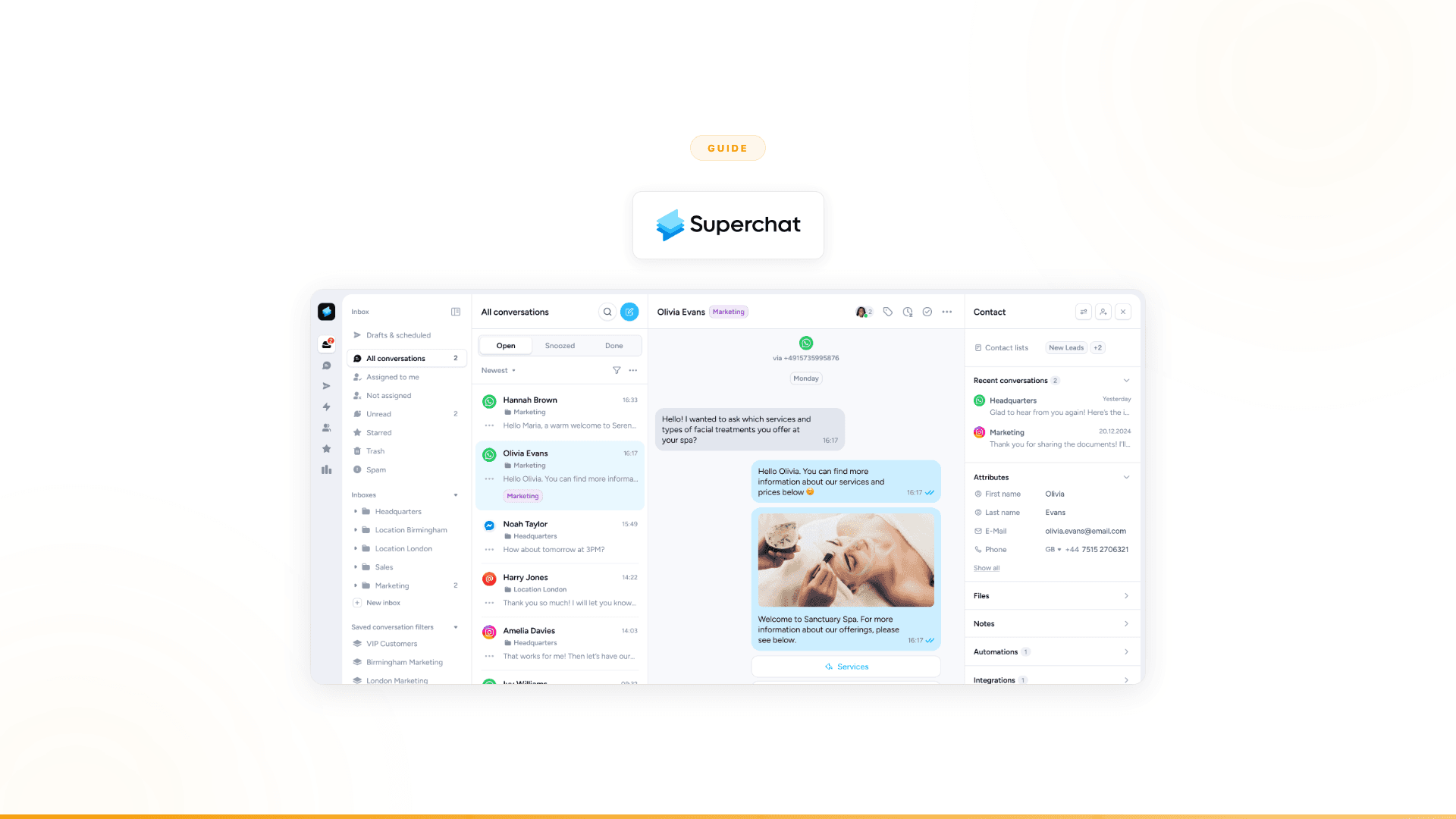
SMB Messaging Tools: 7 Enterprise Limits (2026)
Team leads loved Superchat at a 50-person company. Here are 7 dimensions where SMB messaging tools hit their ceiling at enterprise scale.
The pattern starts the same way every time.
A team lead or department manager used Superchat, Trengo, Tidio, or Crisp at a previous company. Maybe a 50-person insurance brokerage or a regional e-commerce operation. The tool was fast to deploy, the team adopted it quickly, and customer conversations were finally organized. WhatsApp, Instagram, and email came into one inbox. Response times improved. It felt like a clear win.
So they bring it to the enterprise. They pitch it to leadership. Sometimes they run a pilot in their own department. And then procurement gets involved. IT security sends a questionnaire. Operations maps out the actual workflow requirements. The compliance team asks about audit trails. And what worked brilliantly for a 50-person team starts to show its edges.
This is not an article about any tool being bad. Superchat is well-built for SMBs. Trengo solves real problems for growing businesses. Tidio and Crisp serve their markets productively. The issue is structural. Tools designed for one scale hit predictable limits at another. Knowing where those limits are saves months of evaluation and workarounds.
Here are the seven dimensions where SMB messaging platforms reach their ceiling at enterprise scale, and what the gap actually looks like in practice.
The 7 dimensions at a glance
| Dimension | SMB messaging tools | Enterprise requirement |
|---|---|---|
| Integration depth | Zapier/Make connectors, trigger-action model | Native API orchestration across 200+ systems with transactional integrity |
| Security certifications | GDPR compliance | SOC 2 Type II, ISO 27001, ISO 42001, sector-specific certs |
| User and permission management | Simple role tiers (admin, agent) | RBAC, SSO/SAML, SCIM provisioning, feature-level permissions |
| Scale economics | Per-seat pricing, reasonable at 5-50 agents | Cost model that does not break at 100+ agents and millions of interactions |
| Compliance and audit trails | Conversation exports, tagging | Decision traceability, automated compliance enforcement, regulatory-grade audit |
| Multi-market operations | Multilingual interface, translation | Market-specific business logic, per-jurisdiction compliance, localized workflows |
| Vendor support model | Help center, docs, email support | Embedded engineering, integration architecture, change management |
1. Integration depth: Zapier triggers vs native API orchestration
What SMB tools offer. Superchat, Trengo, and similar platforms integrate with business tools through Zapier, Make, and basic API connectors. When a WhatsApp message arrives, you can trigger a workflow: add a contact to HubSpot, send a Slack notification, create a row in Google Sheets. For SMBs running 5 to 15 tools, this covers most needs and does so reliably.
What enterprise requires. Enterprise operations run 200 to 1,500 applications. ERP, CRM, BSS/OSS, billing, compliance databases, identity verification, provisioning systems, internal knowledge bases. The workflows that matter span multiple systems simultaneously. A single customer interaction might require reading from three systems, applying decision logic, writing to two others, and logging every step for compliance.
The gap. Zapier-level integrations operate on a trigger-action model. Event A happens, do Action B. They are not designed for transactional workflows where an agent needs to query a billing system for the current plan, check eligibility in a rules engine, validate compliance in a regulatory database, execute a change, and trigger provisioning, all within a single interaction while maintaining data consistency.
The workaround and why it fails. Teams build increasingly complex Zapier chains with conditional logic, error-handling zaps, and manual checkpoints. The result is a fragile middleware layer that no one fully understands and that breaks whenever a downstream API changes. One enterprise team described their setup as "40 Zaps held together by naming conventions and hope." When something fails mid-chain, there is no rollback. Data ends up inconsistent across systems, and humans spend more time debugging integrations than they saved.
2. Security certifications: GDPR baseline vs enterprise security architecture
What SMB tools offer. GDPR compliance. Data encrypted in transit and at rest. A privacy policy. For SMBs in Europe, this meets legal requirements and is appropriate for their risk profile.
What enterprise requires. Enterprise procurement sends a security questionnaire. It asks about SOC 2 Type II certification, ISO 27001 compliance, ISO 42001 (AI-specific governance), penetration testing cadence and results, incident response procedures, subprocessor management, data residency controls, and audit logging of administrator actions. Depending on the industry, you may also need PCI DSS, HIPAA, or sector-specific certifications.
The gap. This is not about SMB tools being insecure. It is about a different risk calculus. When a platform handles millions of customer interactions across regulated industries, the security infrastructure needs to match. Data residency (keeping French customer data in France, German data in Germany) is a regulatory requirement in telecom, finance, and healthcare. Penetration testing needs to happen on a defined cadence with results available for review.
The workaround and why it fails. The pilot works. It generates enthusiasm. Then the security review blocks the enterprise-wide rollout. IT security does not approve platforms that lack certifications their compliance framework requires, regardless of how well the product functions. Some teams try to work around this by keeping the tool scoped to a single department and classifying data as low-sensitivity. That works until the tool handles customer PII, which it inevitably does in any messaging platform.
3. User and permission management: simple roles vs RBAC, SSO, and SCIM
What SMB tools offer. Two or three role tiers: admin, manager, agent. Everyone on the team gets an account with a username and password. Permissions are broad. This is perfectly adequate when you have 8 people on the support team and they all need the same access.
What enterprise requires. Role-based access control (RBAC) with granular permissions: which teams can see which customer data, who can modify agent configurations, who can access conversation logs from specific markets, who can deploy changes to production. Single sign-on (SSO) through SAML or OpenID Connect, integrated with the enterprise identity provider. SCIM provisioning so that when someone joins or leaves the organization, their access is created or revoked automatically.
The gap. Managing 500 agents across 12 markets with different access requirements is not the same problem as managing 10 agents on one team. Without RBAC, you cannot enforce the principle of least privilege. Without SSO, you have another set of credentials to manage outside the enterprise identity stack. Without SCIM, every onboarding and offboarding creates manual work for IT.
The workaround and why it fails. Teams create shared accounts per department or use a single admin account with a shared password. This violates every enterprise security policy. When an incident occurs, there is no way to trace actions to individuals. Audit logs become meaningless because five people are logged in as "support-team-berlin."
4. Scale economics: pricing that works at 50 agents, breaks at 500
What SMB tools offer. Per-seat pricing designed for teams of 5 to 50. Superchat starts at EUR 79 per month for 3 users, with EUR 10 per additional user. Trengo, Tidio, and Crisp follow similar models. At SMB scale, this is reasonable and predictable.
What enterprise requires. A cost model that does not become prohibitive at 100+ agents handling millions of interactions. Per-seat pricing compounds linearly, but the value delivered per agent does not increase proportionally.
The gap. Three things break at enterprise scale. First, pricing economics. A platform that costs EUR 300 per month for an SMB team might cost EUR 30,000 per month for 300 agents, before add-ons for additional WhatsApp numbers, AI features, and premium channels. At that point, the enterprise is paying enterprise prices for SMB infrastructure. Second, performance. Platforms designed for thousands of monthly conversations may experience latency or reliability issues at 100x their design throughput. Third, operational management. Centralized reporting, cross-market analytics, and hierarchical administration are not features SMB tools build, because their customers do not need them.
The workaround and why it fails. Departments buy separate instances to stay within budget tiers. Marketing has one Superchat account, support has another, the Berlin office has a third. Customer data is fragmented. Reporting requires manual consolidation. The customer who messaged on WhatsApp yesterday and calls today appears as two different people in two different systems.
5. Compliance and audit trails: conversation logs vs decision traceability
What SMB tools offer. The ability to tag conversations, add notes, and export chat logs. Some offer basic templates for common responses. This provides a record of customer interactions that satisfies basic business needs.
What enterprise requires. In regulated industries, compliance is not documentation after the fact. It is enforcement during the process. Every customer interaction must follow specific procedures. Disclosures must be delivered at specific points. Consent must be captured and stored in auditable formats. Escalation rules must be followed precisely. And all of this must be provable to regulators months or years later.
The gap. Conversation logs tell you what was said. Enterprise audit requirements go further. When an AI agent makes a decision (approves an upgrade, denies a request, routes an exception), the audit trail needs to capture what data informed the decision, which business rules were applied, what alternatives existed, and why the specific outcome was selected. If a customer disputes a decision six months later, you need to reconstruct exactly what happened and why.
The workaround and why it fails. Teams manually document compliance steps in spreadsheets or internal wikis alongside the messaging tool. The process depends on individual agents remembering to log every step. When a regulator asks for proof that every interaction followed the required procedure, you have a chat export and a human-maintained spreadsheet. That is not the same as an integrated audit trail with decision traceability. One European telecom maintains full regulatory compliance across millions of interactions specifically because compliance is built into the workflow architecture, not bolted on through manual documentation.
6. Multi-market operations: translation vs operational complexity
What SMB tools offer. Multilingual interfaces and AI responses. Superchat supports multiple languages. Crisp offers real-time translation. For an SMB operating in one or two markets, this covers the need.
What enterprise requires. A telecom operator running in 8 European markets does not just need messages translated. They need agents that handle different regulatory frameworks per country, different product catalogs, different compliance requirements, different backend systems, and different customer expectations. The same workflow (customer onboarding) works differently in France, Germany, Poland, and Belgium because the regulations, systems, and processes differ.
The gap. This is not a translation problem. It is an operational complexity problem. The platform needs to manage market-specific business logic, connect to market-specific backend systems, and enforce market-specific compliance rules while maintaining a consistent experience and centralized reporting across all markets. Orange deployed Nexus agents across multiple European markets with market-specific workflows and compliance rules, managed from a single platform.
The workaround and why it fails. Teams run separate instances per market. Each market configures its own tool independently. There is no cross-market visibility, no shared learning, and no way to enforce consistent standards. When headquarters needs a consolidated view of customer interactions across markets, someone spends two days building a spreadsheet.
7. Vendor support model: help center vs embedded engineering
What SMB tools offer. Documentation, a help center, video tutorials, and email or chat support. For SMBs configuring a shared inbox and setting up auto-replies, this is the right level of support. The product is designed to be self-serve, and that is a feature, not a limitation.
What enterprise requires. Enterprise deployments are integration projects. They involve connecting to complex backend systems, building custom workflow logic, handling edge cases specific to the business, and iterating on agent behavior based on production data. The difference between a successful enterprise AI deployment and a failed one is rarely the platform features. It is the depth of engineering support during implementation.
The gap. When you hit a limitation or an edge case with an SMB tool, you file a support ticket and wait. When you are trying to integrate a messaging platform with a legacy billing system that uses SOAP APIs and a custom authentication scheme, you need engineers who understand both the platform and enterprise integration architecture sitting next to your team.
The workaround and why it fails. Enterprises hire external consultants or internal developers to build a bridge between the SMB tool and their systems. The result is a custom integration layer that the vendor does not support, that the consultants who built it have moved on from, and that your team inherits as technical debt. When the vendor updates their API, the custom layer breaks, and no one knows why.
The honest graduation framework
Not every enterprise needs to move beyond SMB messaging tools. Here is a framework for evaluating where you are.
You are likely fine with SMB tools if:
- Customer interactions are primarily conversational (questions, scheduling, simple support)
- Your backend systems number fewer than 10
- Your compliance requirements are limited to GDPR
- You operate in 1 to 2 markets with the same regulatory framework
- Monthly interaction volume stays under 50,000
- Your security review does not require SOC 2 or ISO 27001
- Your support team has fewer than 50 agents
You should evaluate enterprise platforms if:
- Customer interactions trigger multi-system backend workflows
- You operate in regulated industries (telecom, finance, healthcare, insurance)
- You serve multiple markets with different regulatory requirements
- Interaction volume exceeds 100,000 per month
- Procurement requires SOC 2, ISO 27001, or sector-specific certifications
- You need more than 100 agents with differentiated access
- You need AI that completes work, not just conversations
The threshold is not about company size. It is about operational complexity. A 200-person fintech with strict compliance requirements may hit the ceiling before a 2,000-person retailer with simple support needs.
What the transition looks like
When requirements cross the threshold, the evaluation criteria shift fundamentally. You are no longer comparing inbox features, channel count, and chatbot builders. You are evaluating integration depth, compliance architecture, scale economics, and engineering support.
The category distinction matters here. SMB messaging tools automate conversations. Enterprise platforms complete the work behind those conversations. That is not a feature gap you can bridge with add-ons or more Zapier zaps. It is an architectural difference between conversational AI and agentic AI that determines what the platform is structurally capable of doing.
Orange did not need a better inbox. Their previous chatbot had a 27% drop-out rate because it could hold a conversation but could not complete the work behind it. They deployed Nexus agents that complete customer onboarding end-to-end. 50% conversion improvement. $6M+ yearly revenue. 4 weeks to deploy. Business team built it, not engineering.
A European telecom with 13,000+ employees did not need smarter message routing. They needed agents across support, compliance, registration, and escalation handling. 40% of support capacity freed. Full regulatory compliance maintained across millions of interactions.
The tools that got you here were the right tools for that stage. Recognizing when to graduate is how you avoid spending six months trying to make a conversation tool do workflow work.
Worth exploring?
Every Nexus engagement starts with a 3-month proof of concept tied to measurable outcomes. Forward Deployed Engineers embed with your team from day one. You see the results before committing. You can exit anytime.
100% of clients who started a POC converted to an annual contract. Every one.
See the full Nexus vs Superchat comparison -->
Related reading
Your next
step is clear
The only enterprise platform where business teams transform their workflows into autonomous agents in days, not months.