
Conversational AI vs Agentic AI: The Difference
Conversational AI automates the dialogue. Agentic AI completes the work behind it. Here are the 5 architecture differences and when each category fits.
These two terms keep showing up in the same conversations, often used interchangeably. They are not the same thing. They describe two fundamentally different architectures that solve different problems, measure different outcomes, and require different evaluation criteria.
Conversational AI automates the dialogue between a customer and a business. Agentic AI completes the work that dialogue is about.
That distinction sounds like a detail. It is not. It determines what the software can do, what it cannot do, and what results you should expect from deploying it. This article walks through the architecture differences, names specific products in each category, and provides a framework for deciding which one your organization actually needs.
What conversational AI is
Conversational AI platforms are designed to automate conversations. Their architecture revolves around understanding what a person said (intent recognition, natural language understanding), generating an appropriate response, and managing the flow of a multi-turn dialogue across one or more messaging channels.
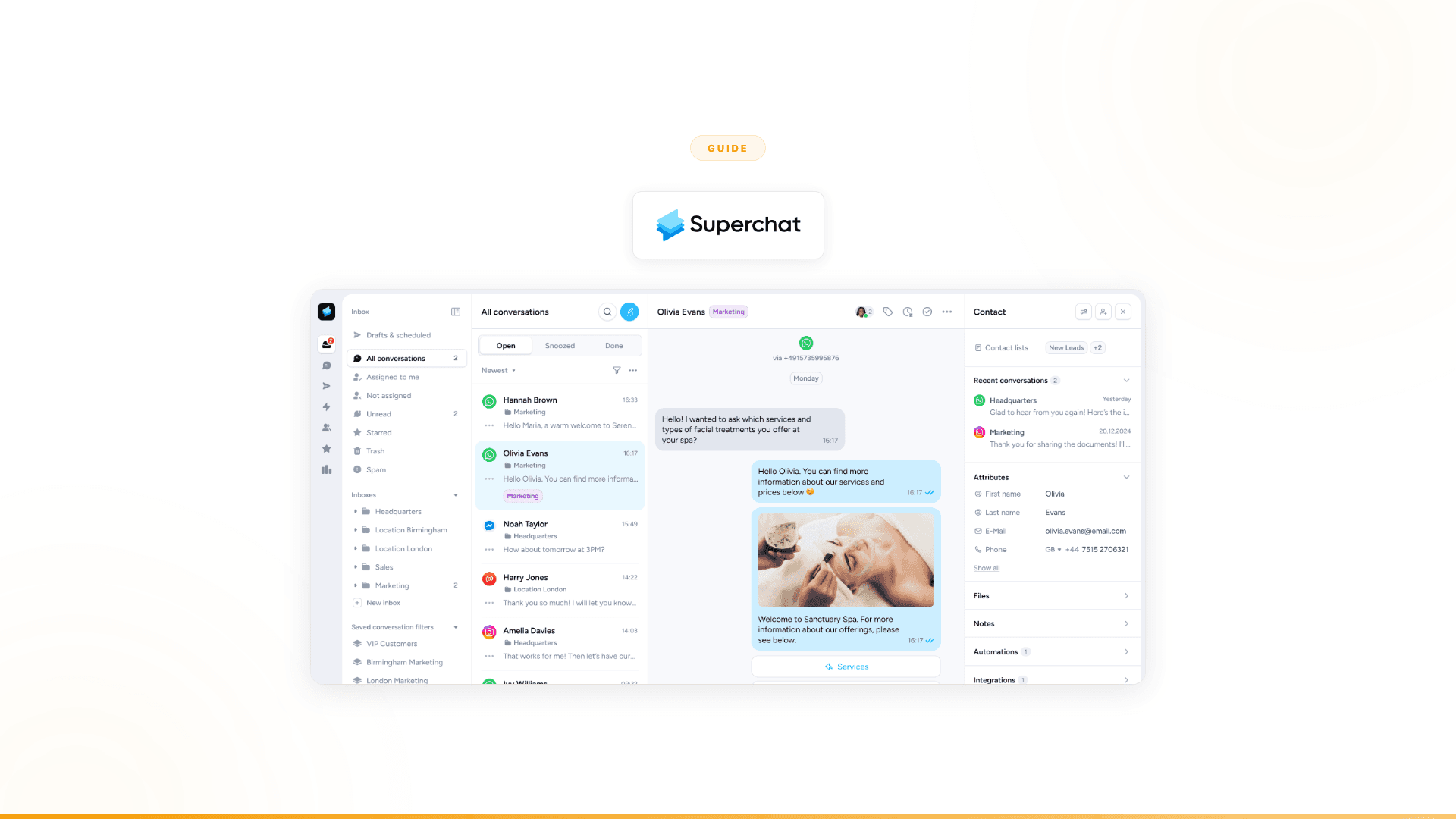
The category is mature. Products like Superchat, Ada, Cognigy, Yellow.ai, Kore.ai, Intercom Fin, and Drift have been in market for years. They share common architectural traits.
The data model is the conversation transcript. Everything is organized around messages, contacts, conversation threads, channels, and inboxes. Analytics measure conversation metrics: response time, deflection rate, resolution rate, CSAT scores.
The AI focuses on natural language understanding. Can the system correctly interpret "I want to change my plan" and generate a helpful response? Can it handle follow-up questions? Can it switch topics mid-conversation without losing context?
Integrations are channel connectors. The primary integration layer connects messaging channels (WhatsApp, webchat, Instagram, email, voice) to the platform. Backend system connections exist, but they are typically read-only: pull data to inform a response, not write data to execute an action.
The outcome is conversation automation. Success means customers get faster responses, human agents handle fewer routine inquiries, and the support team can focus on complex cases. These are real, valuable outcomes.
For the problem they solve, modern conversational AI platforms work well. Language understanding has improved dramatically. Multi-turn dialogues, multi-language support, and omnichannel deployment are now table stakes. If the conversation is your bottleneck, these tools deliver.
What agentic AI is
Agentic AI platforms are designed to complete business processes autonomously. Their architecture revolves around connecting to multiple backend systems, applying business logic, making decisions within defined guardrails, handling exceptions, and executing multi-step workflows end-to-end.
The conversation, if there is one, is an input/output interface. The product is the work.
The data model is workflow state. Everything is organized around processes, system connections, business rules, decision points, actions taken, and outcomes produced. Analytics measure operational metrics: workflow completion rate, autonomous resolution rate, processing time, error rate, revenue impact.
The AI focuses on decision-making and execution. Given data from a billing system, a CRM, and a compliance database, what action should be taken? When should the agent escalate? How should a data inconsistency between two systems be resolved? Language understanding is one input to the decision. It is not the product.
Integrations are system orchestration. Backend systems (CRM, ERP, BSS/OSS, compliance databases, provisioning platforms) are first-class participants in workflows. The agent reads from and writes to these systems, maintains data consistency across them, and handles authentication and access control.
The outcome is work completion. Success means business processes that previously required human coordination across multiple systems now happen autonomously. The metric is not fewer conversations handled. It is fewer manual process steps, faster end-to-end completion, and measurable business outcomes: revenue generated, costs reduced, compliance maintained.
Nexus is an example of this category. More on what that looks like in production below.
The architecture comparison
| Dimension | Conversational AI | Agentic AI |
|---|---|---|
| Core purpose | Automate customer dialogues | Complete business processes end-to-end |
| Data model | Conversation transcripts, messages, contacts | Workflow state, decision logs, system records |
| AI focus | Natural language understanding and generation | Decision-making, validation, and execution |
| Integration model | Channel connectors (WhatsApp, web, voice) | System orchestration (CRM, ERP, billing, compliance) |
| Error handling | Fallback to human agent on misunderstood intent | Autonomous exception handling within guardrails |
| Compliance scope | Conversation logging and disclosure management | Full workflow audit trail with decision traceability |
| What it automates | ~10% of effort (the dialogue layer) | ~90% of effort (the work behind the dialogue) |
| Key metrics | Deflection rate, CSAT, response time | Completion rate, revenue impact, autonomous resolution |
| Example products | Ada, Cognigy, Yellow.ai, Kore.ai, Superchat, Intercom, Drift | Nexus |
Five architecture differences explained
The table above summarizes the split. Here is what each difference means in practice.
1. Data model: conversation transcript vs workflow state
A conversational AI platform stores what was said. The data model is a sequence of messages between a customer and the system, organized by channel, contact, and time. When an interaction ends, the system has a transcript and a resolution status.
An agentic AI platform stores what happened. The data model tracks which systems were queried, what data was retrieved, which business rules were applied, what decisions were made, what actions were executed, and what the outcome was. When an interaction ends, the system has a complete record of every step in the business process, not just the dialogue.
This matters because the conversation transcript tells you what the customer asked. The workflow state tells you what was done about it, and why.
2. AI focus: natural language understanding vs decision-making and execution
Conversational AI invests its intelligence in language. Parsing ambiguous requests ("I think something is wrong with my bill, maybe the data part?"), maintaining context across a long conversation, handling code-switching between languages, generating responses that sound natural.
Agentic AI invests its intelligence in deciding what to do. A customer wants to change their plan. The agent needs to check their current contract terms, validate eligibility for the new plan, calculate proration, verify there are no outstanding compliance holds, execute the change in the billing system, update the CRM, and confirm with the customer. The language part of this interaction is straightforward. The operational logic is not.
Both forms of AI intelligence are valuable. The question is where your complexity sits. If your team spends most of its time understanding what customers mean, conversational AI addresses that directly. If your team spends most of its time navigating systems and applying business logic after they already understand what the customer wants, that is a different problem.
3. Integration model: channel connectors vs system orchestration
Conversational AI platforms excel at connecting messaging channels. Superchat connects WhatsApp, Instagram, email, and webchat into a unified inbox. Kore.ai handles voice, digital, and messaging across dozens of channels. These channel integrations are deep and well-engineered.
Backend integrations in conversational AI platforms typically work differently. They pull data to inform responses ("Your current plan is X, your balance is Y"). They rarely write data back to those systems. They do not orchestrate multi-step transactions across multiple backends. The architecture was not designed for that because the product is the conversation, not the work behind it.
Agentic AI platforms treat backend systems as the primary integration layer. The agent connects to a CRM, a billing system, a compliance database, and a provisioning platform not to inform a response but to execute a process. It reads, validates, decides, writes, and confirms across all of them in a single interaction.
For enterprises where customer interactions trigger operational processes (which is most enterprises), this distinction determines whether the AI handles the surface or the substance.
4. Error handling: fallback to human vs autonomous exception handling
When a conversational AI platform encounters something it cannot handle, the standard response is escalation: transfer the customer to a human agent, often with context from the conversation so far. This is the designed behavior. The platform recognizes its limits and routes accordingly.
When an agentic AI platform encounters an exception, it handles it within defined guardrails. A system is unavailable, so the agent retries or uses a fallback data source. Data is inconsistent between two systems, so the agent applies reconciliation rules. A business rule produces an edge case, so the agent escalates with full operational context (not just conversation context) to a human who can make the judgment call.
The difference is between "I do not understand, let me get someone" and "this data does not match, here are the three options within policy, and here is why I recommend option B." One hands off the problem. The other works through it.
5. Compliance scope: conversation logging vs full workflow audit trail
Conversational AI provides conversation records: what was said, when, on which channel, by whom. For regulated industries, it can ensure certain disclosures are included in dialogues and that specific phrases are avoided. This is useful and often required.
Agentic AI provides process records: what data was accessed, from which system, what business rule was applied, what decision was made, why, and what action was taken as a result. Every step is logged, traceable, and auditable. When a regulator asks "why was this customer's request handled this way," the audit trail shows the complete chain from request to resolution, not just the conversation about it.
For industries like telecom, financial services, and healthcare, where regulatory scrutiny extends beyond what was communicated to what was done, this distinction determines whether your AI deployment is fully auditable or only partially so.
The 10/90 framework
The clearest way to understand the practical impact of this category split is the 10/90 framework.
When a customer contacts a business, the conversation represents roughly 10% of the total effort involved. Understanding the request, asking clarifying questions, providing a response. That is the dialogue layer.
The other 90% is what happens behind the conversation: identifying the customer in the CRM, retrieving account data from the billing system, checking eligibility against business rules, validating compliance requirements, executing the requested change across backend systems, logging every step for audit, and confirming completion.
Conversational AI platforms automate the 10%. Agentic AI platforms automate the 90%.
This is why organizations that deploy conversational AI often report improved customer satisfaction (the channel experience is better) but limited operational cost reduction (the work behind the conversation is unchanged). The investment optimized the smaller portion of the total effort. Not because the tool failed, but because the tool was designed for a different scope.
Products in each category
Conversational AI platforms:
- Ada focuses on customer service ticket deflection. Strong NLU, good at handling common support questions across digital channels. Does not execute backend workflows.
- Cognigy targets enterprise contact centers with voice and chat automation. Sophisticated conversation design tools. Operations behind the conversation stay manual.
- Yellow.ai provides multi-language, multi-channel conversational AI across 135+ languages. Particularly strong in APAC and Middle East markets. Automates conversations, not workflows.
- Kore.ai builds enterprise virtual assistants with complex multi-turn dialogue across voice and digital channels. Recognized by Gartner as a Leader. Same category scope.
- Superchat unifies WhatsApp, Instagram, email, and webchat into a shared inbox with AI-powered FAQ automation. Built for SMBs. Does not handle enterprise-scale operations.
- Intercom Fin resolves customer questions using help center content and past conversations, natively within the Intercom platform. Per-resolution pricing.
- Drift (Salesloft) automates the sales conversation layer: lead qualification, meeting booking, prospect routing. Same architecture, different department.
These are capable, mature products. For the problem they solve, they work well.
Agentic AI platforms:
- Nexus deploys autonomous agents that complete entire business processes end-to-end. Agents connect to backend systems, apply business logic, make decisions within guardrails, handle exceptions, and execute multi-step workflows. Forward Deployed Engineers embed with the customer's team. Business teams build and own the agents without engineering dependencies.
What that looks like in production:
Orange Group (multi-billion euro telecom, 120,000+ employees) previously ran a conversational AI platform on WhatsApp. It handled customer conversations. It had a 27% drop-out rate because it could talk to customers but could not complete their requests. Nexus agents replaced it with agentic AI that completes the full onboarding workflow: verification, eligibility, plan setup, billing, confirmation. 50% conversion improvement. Over $6M in yearly revenue. 90% autonomous resolution. Deployed in 4 weeks. Built by the business team.
A European telecom (13,000+ employees) deployed Nexus agents across support, compliance, registration, and escalation handling. The agents freed 40% of support capacity across millions of interactions while maintaining full regulatory compliance. Not by having better conversations, but by completing the work those conversations were about.
These outcomes are structurally unavailable to conversational AI platforms, regardless of how sophisticated their language understanding becomes. The limitation is not a feature gap. It is an architecture gap.
The industry is making this distinction explicit
This is not an abstract categorization exercise. The enterprise AI industry is actively reorganizing around it.
MWC 2026 (March 2-5, Barcelona) featured a dedicated Agentic AI Summit for the first time. Telecom operators, technology vendors, and industry analysts spent three days explicitly distinguishing between conversational AI and agentic AI as separate categories with different architectures, different evaluation criteria, and different outcomes. The framing across the event was not "better chatbots." It was "autonomous business process completion."
Analyst firms have begun segmenting the market along this line, recognizing that platforms built around conversations and platforms built around workflows serve different buyer needs. Enterprise buyers are shifting their evaluation frameworks accordingly. The question is moving from "which chatbot platform should we use" to "which platform can complete our highest-value workflows autonomously."
This matters for evaluation because a comparison between a conversational AI platform and an agentic AI platform is not a vendor comparison. It is a category comparison. Evaluating them against the same criteria is like comparing a phone system to an ERP. Both are useful. They do fundamentally different things.
When to pick each category
If you are evaluating AI platforms, the first decision is which category you need. The vendor decision comes after.
Conversational AI is the right category if:
- Your primary goal is improving the customer messaging experience across channels
- Customer interactions are primarily informational (questions and answers, not process triggers)
- The work behind customer interactions is minimal or already well-automated by other systems
- Your key metrics are conversation handling efficiency: response time, deflection rate, CSAT
- Your team's bottleneck is understanding and responding to customers, not executing on their requests
Agentic AI is the right category if:
- Customer interactions trigger multi-step workflows across multiple backend systems
- The operational cost sits in the work behind conversations, not in the conversations themselves
- You need AI that executes actions across systems, not just generates responses
- Your metrics are end-to-end process completion, autonomous resolution rate, and business outcomes (revenue, cost reduction, compliance)
- Your team's bottleneck is navigating systems and applying business logic, not understanding what the customer wants
For many enterprises, especially those in complex regulated operations like telecom, the conversation was never the bottleneck. The work behind it was.
The honest framing
Conversational AI is a valuable, mature category. For organizations where the conversation is the primary bottleneck, these platforms deliver real improvements. Choosing one of Ada, Cognigy, Yellow.ai, Kore.ai, Intercom, or any of the established players in this space is a sound decision for the right use case.
But if the reason you are evaluating AI is that operational costs have not decreased despite deploying conversation automation, the problem is not which conversational AI platform you use. The problem is that conversation automation structurally cannot reach the 90% of work that sits behind those conversations. No amount of switching between vendors within the same category changes that.
Orange did not need a better chatbot. Their chatbot could hold conversations. It could not complete onboarding workflows. $6M+ in yearly revenue came from agents that do the work, not agents that talk about it.
A European telecom did not need smarter ticket routing. They needed agents that handle support, compliance, registration, and escalation across millions of interactions. 40% of support capacity freed. Not from better conversations. From completed work.
That gap, between deflecting a conversation and completing the process it represents, is not a feature gap. It is a category gap.
Worth exploring?
Every Nexus engagement starts with a 3-month proof of concept tied to measurable outcomes. Forward Deployed Engineers embed with your team from day one. You see the results before committing. You can exit anytime.
100% of clients who started a POC converted to an annual contract. Every one.
Related reading
Your next
step is clear
The only enterprise platform where business teams transform their workflows into autonomous agents in days, not months.