
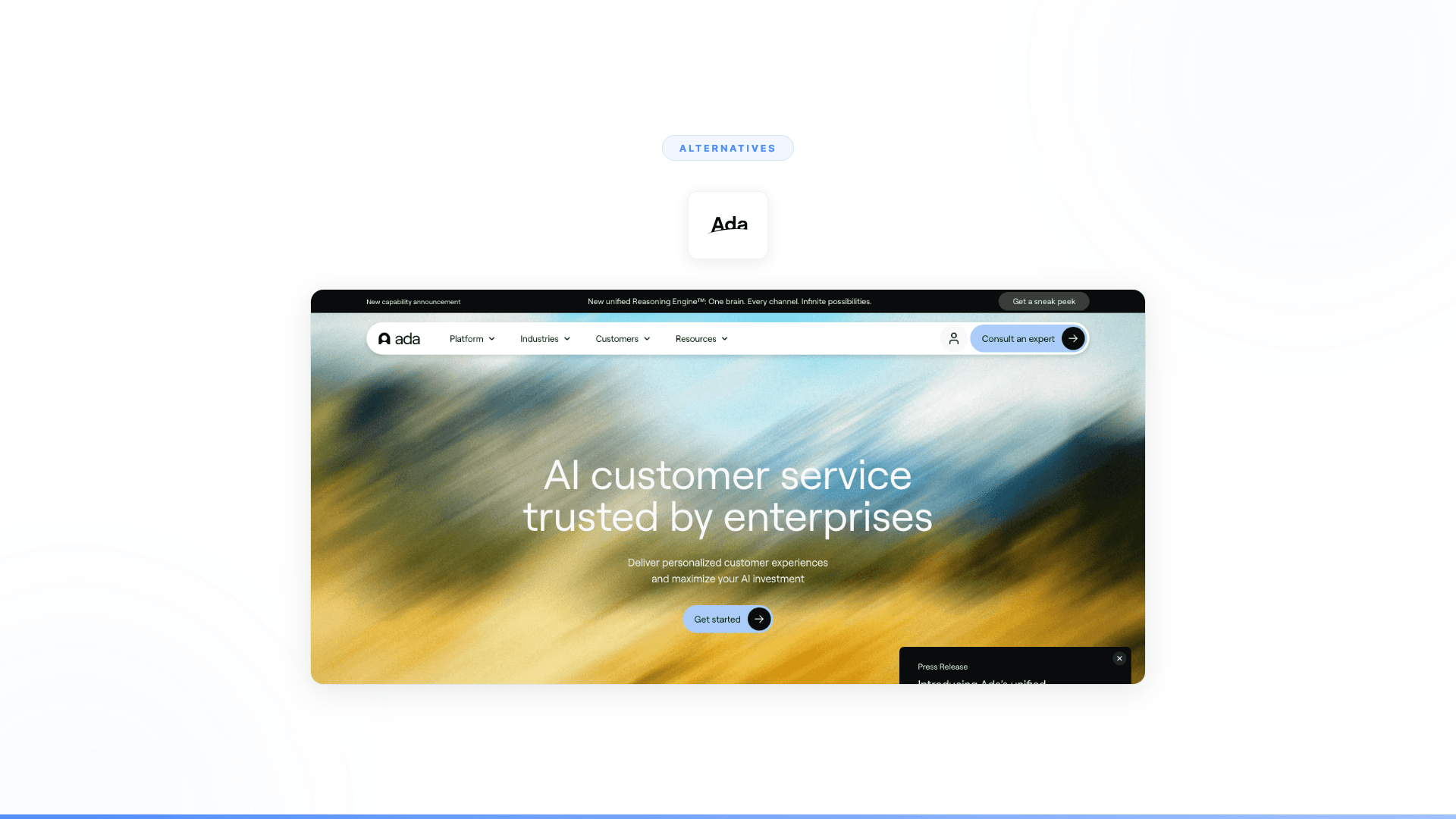
Top 10 Ada Alternatives for Customer Service AI in 2026
Ada deflects tickets. These 10 alternatives go further. From conversation automation to full workflow completion, here are the best Ada alternatives ranked by what they actually deliver.
Ada is good at what it does. It automates customer service conversations. It deflects tickets. It reduces the load on human agents for common, predictable questions.
But most teams searching for Ada alternatives aren't looking because the chatbot failed. They're looking because it succeeded at the wrong thing.
The pattern goes like this: you deploy Ada, ticket volume drops for the easy stuff, leadership celebrates. Then the numbers plateau. Complex cases still go to humans. The operational work behind every ticket (pulling records, validating data, checking compliance, coordinating across systems) stays completely manual. Your team handled 40% fewer conversations but still does 95% of the same work. The chatbot deflected the ticket. Nobody completed the work the ticket was about.
That's not an Ada problem. It's a category problem. Conversational AI automates the dialogue layer, roughly 10% of what customer service actually involves. The other 90%, the cross-system validation, decision logic, exception handling, and action, sits untouched.
If that gap is what's driving your search, here are 10 alternatives worth evaluating. They range from other conversation tools to platforms that complete the work behind those conversations.
Quick comparison
| Tool | Category | Best for | Completes work behind tickets? | Pricing model |
|---|---|---|---|---|
| Nexus | Autonomous agent platform | Full workflow completion across any department | Yes, end-to-end | Per-agent |
| Intercom Fin | Support AI assistant | AI-first customer messaging | Conversations only | Per-resolution |
| Zendesk AI | Support AI layer | AI within Zendesk ecosystem | Partial (within Zendesk) | Per-resolution add-on |
| Freshdesk Freddy AI | Support AI layer | Budget-friendly support AI | Partial (within Freshdesk) | Per-agent add-on |
| Tidio | Chatbot + live chat | SMB support automation | Conversations only | Per-seat |
| Drift (Salesloft) | Conversational marketing | Sales-focused chat and scheduling | Conversations only | Platform license |
| Kore.ai | Enterprise conversational AI | Multi-channel virtual assistants | Conversations only | Enterprise license |
| Yellow.ai | Conversational AI platform | Multi-language support automation | Conversations only | Enterprise license |
| Forethought | Support AI | Ticket triage and auto-resolution | Partial (triage + simple actions) | Per-ticket |
| Custom build | Developer framework | Full control, unlimited scope | Depends entirely on team | Engineering cost |
The alternatives, ranked
1. Nexus
What it is: An autonomous agent platform with embedded Forward Deployed Engineers. Nexus agents don't just handle the conversation. They complete the entire business process behind it: collecting data from multiple systems, validating it, making decisions within guardrails, handling exceptions, and executing actions. Any department. Any workflow. Business teams build and own the agents.
Why teams switch from Ada to Nexus:
Ada deflects tickets. Nexus agents complete the work those tickets are about. That's not a feature difference. It's a category difference.
When a customer contacts your business, the conversation (understanding their request, answering their question) is roughly 10% of the effort. The other 90% is what happens behind that conversation: pulling records from the CRM, checking compatibility in backend systems, validating compliance, creating records, routing exceptions, sending confirmations. Ada automates the 10%. Nexus agents complete the 90%.
What it looks like in production:
- Orange Group (multi-billion euro telecom, 120,000+ employees): Replaced their previous CX chatbot platform (which had a 27% drop-out rate) with Nexus agents that complete customer onboarding end-to-end. Deployed in 4 weeks. 50% conversion improvement. ~$6M+ yearly revenue. 90% autonomous resolution. Built by the business team, not engineering.
- European telecom (13,000+ employees): Needed agents across support, compliance, registration, and escalation handling. Not just a chatbot on the website. Nexus agents freed 40% of support capacity across millions of interactions while maintaining 100% regulatory compliance.
- Lambda ($4B+ AI infrastructure company): Their CTO considered building internally but chose Nexus. Agents monitor 12,000+ accounts and surface pipeline opportunities autonomously. $4B+ pipeline discovered.
Pricing: Per-agent, tied to value delivered. Not per-resolution. An agent handling millions of interactions costs the same regardless of volume.
Best for: Teams that have realized ticket deflection is 10% of the problem, and the real cost sits in the operational work behind those tickets. Any department, any workflow.
Full Nexus vs Ada comparison -->
2. Intercom Fin
What it is: Intercom's AI assistant for customer support. Fin sits inside the Intercom platform and resolves customer questions using your help center content, past conversations, and custom data sources. It's designed as an AI-first layer on top of Intercom's messaging platform.
How it compares to Ada: Similar scope, different ecosystem. Both automate the conversation layer of customer support. Fin is deeply integrated with Intercom's inbox, routing, and reporting. Ada is platform-agnostic. For existing Intercom customers, Fin is the native option with tighter integration. For teams not on Intercom, Ada offers more flexibility in deployment.
Why it might not solve the problem: Same category limitation. Fin resolves conversations. It answers questions, deflects common tickets, and routes complex cases to humans. The operational work behind those conversations (the multi-system validation, compliance checks, cross-department coordination) stays manual. Switching from Ada to Fin changes the conversation tool. It doesn't change the category.
Pricing: Per-resolution ($0.99 per resolution). Can scale significantly at high volume.
Best for: Existing Intercom customers who want native AI resolution within their current support stack.
3. Zendesk AI
What it is: Zendesk's built-in AI layer for customer service. Includes AI agents (automated resolution bots), intelligent triage (auto-classify and route tickets), agent assist (suggestions for human agents), and generative AI features across the Zendesk suite. Deeply embedded in the Zendesk ecosystem.
How it compares to Ada: Zendesk AI works within Zendesk. Ada works across platforms. If you're already on Zendesk and want AI native to your support stack without adding another vendor, Zendesk AI is the simpler path. Ada offers more specialized conversation design and works regardless of your helpdesk platform.
Why it might not solve the problem: Zendesk AI enhances the Zendesk experience. It triages better, routes smarter, and resolves some tickets automatically. But it operates within the support ticket paradigm. The work behind those tickets (the cross-system processes, the operational complexity) isn't what Zendesk was built to handle. You get better support tooling, not business process completion.
Pricing: AI features bundled with Zendesk plans. Advanced AI is an add-on. Automated resolutions priced per-resolution.
Best for: Zendesk customers who want AI-enhanced support without switching platforms.
4. Freshdesk Freddy AI
What it is: Freshworks' AI layer for Freshdesk. Freddy handles auto-resolution, ticket summarization, response suggestions, and sentiment analysis. It's the budget-friendly option in the support AI space, integrated natively with Freshdesk and Freshworks CRM.
How it compares to Ada: Less specialized but more affordable. Freddy AI comes bundled with Freshdesk plans and adds AI capabilities without a separate vendor or integration project. Ada is more purpose-built for conversation automation with deeper NLU and more sophisticated conversation flows. Freddy is "good enough" AI within a broader support suite.
Why it might not solve the problem: Same fundamental limitation as the others in this category. Freddy makes Freshdesk smarter, but it doesn't complete the work behind tickets. Better triage and faster responses are valuable. They're not workflow completion.
Pricing: Included in Freshdesk Pro and Enterprise plans. Additional Freddy AI credits for higher usage.
Best for: Freshdesk customers who want built-in AI at a lower price point than standalone tools.
5. Tidio
What it is: Chatbot and live chat platform aimed at small and mid-size businesses. Combines AI chatbots (Lyro) with live chat, email, and social messaging in one inbox. Simpler than Ada, with faster setup and lower cost.
How it compares to Ada: Tidio is the lightweight option. Faster to deploy, easier to configure, and significantly cheaper. For SMBs that need basic chat automation (answer FAQs, capture leads, route to agents), Tidio covers the basics without the enterprise complexity. Ada is more powerful for large-scale, complex conversation automation.
Why it might not solve the problem: Tidio solves a smaller version of the same problem. It automates simple conversations for smaller teams. The operational work behind those conversations is still entirely manual. And for growing businesses, Tidio's capabilities plateau quickly when support complexity increases.
Pricing: Free tier available. Paid plans from $29/month. Lyro AI add-on from $39/month.
Best for: Small and mid-size businesses that need affordable chat automation without enterprise complexity.
6. Drift (Salesloft)
What it is: Conversational marketing and sales platform, now part of Salesloft. Drift focuses on the sales side of customer interaction: chatbots that qualify leads, book meetings, and route prospects to sales reps. Less focused on support, more focused on revenue.
How it compares to Ada: Different focus entirely. Ada automates support conversations (post-sale). Drift automates sales conversations (pre-sale). They rarely compete head-to-head. If the reason you're leaving Ada is that you need AI for sales engagement rather than support deflection, Drift addresses a different part of the customer journey.
Why it might not solve the problem: Drift automates the conversation layer of sales, not the work behind it. It books meetings and qualifies leads through dialogue, but it doesn't complete the sales process: the research, the CRM updates, the pipeline management, the competitive intelligence. Same category limitation, different department.
Pricing: Platform licensing. Enterprise pricing from $2,500/month.
Best for: Sales teams that need conversational lead qualification and meeting scheduling.
7. Kore.ai
What it is: Enterprise conversational AI platform. Builds virtual assistants for customer support, IT helpdesk, and HR across multiple channels (web, mobile, voice, messaging). Recognized by Gartner as a Leader in Enterprise Conversational AI. Stronger NLU and more enterprise features than Ada.
How it compares to Ada: More enterprise-capable for complex conversation design. Kore.ai handles multi-turn dialogues, complex intent hierarchies, and multi-channel deployment at scale. Ada is simpler to set up for standard support use cases. If you need sophisticated conversation flows across voice and digital channels with enterprise governance, Kore.ai is the more capable platform.
Why it might not solve the problem: Conversations are still 10% of the problem. Kore.ai builds better conversations. More sophisticated, more channels, more enterprise features. But the 90% behind those conversations (the cross-system work, the decision logic, the compliance checks, the exception handling) stays manual. A better conversation tool doesn't become a workflow completion engine.
Pricing: Enterprise licensing, typically $300K+ annually for large deployments.
Best for: Large enterprises that need sophisticated, multi-channel conversational AI with strong NLU and governance.
8. Yellow.ai
What it is: Conversational AI platform with strong multi-language support. Automates customer interactions across 35+ channels and 135+ languages. Particularly strong in APAC and Middle East markets. Includes voice AI capabilities and integration with enterprise CRM and ITSM tools.
How it compares to Ada: Yellow.ai's multi-language and multi-channel coverage is broader than Ada's. For global operations with customers across many languages and regions, Yellow.ai handles the localization complexity that Ada addresses less comprehensively. Ada is more focused on the English-speaking SaaS support use case.
Why it might not solve the problem: Broader language support doesn't change the category. Yellow.ai automates conversations in more languages. The operational work behind those conversations (the same cross-system validation, decision logic, and exception handling) stays manual in every language.
Pricing: Enterprise licensing with usage-based components.
Best for: Global enterprises with multi-language, multi-channel support requirements, particularly in APAC and Middle East markets.
9. Forethought
What it is: AI platform for customer support that focuses on intelligent triage and automated resolution. Forethought classifies incoming tickets, routes them to the right team, and resolves simple cases automatically. Integrates with Zendesk, Salesforce, and other helpdesk platforms.
How it compares to Ada: Forethought emphasizes the triage and routing layer more than Ada. While Ada focuses on the customer-facing conversation, Forethought works more behind the scenes: classifying tickets, predicting priority, and auto-resolving cases that match known patterns. The two tools complement different parts of the support workflow.
Why it might not solve the problem: Better triage is valuable but limited. Forethought routes tickets faster and resolves the simple ones. The complex cases (the ones that actually cost the most) still land with human agents. And the operational work behind every ticket, simple or complex, still requires humans navigating multiple systems. Smarter routing doesn't eliminate the work. It just gets the work to the right person faster.
Pricing: Per-ticket pricing model.
Best for: Support teams with high ticket volume that need smarter triage and routing, particularly those on Zendesk or Salesforce.
10. Custom build
What it is: Building your own customer service AI using developer frameworks (LangChain, LangGraph, CrewAI) or LLM APIs directly. Your engineering team designs the architecture, handles integrations, manages deployment, and maintains the system.
How it compares to Ada: Maximum flexibility. No vendor limitations on scope, capabilities, or integration depth. You can build exactly what your customer service operation needs, including the operational work behind conversations that no vendor tool handles.
Why it might not solve the problem: Most companies don't have surplus AI engineering capacity. Customer service AI that actually completes workflows requires integrations with CRM, ERP, compliance, and dozens of internal systems. Security, governance, monitoring, and maintenance are all on you. Lambda, a $4B+ AI company with world-class engineers, chose to buy from Nexus rather than build because diverting their engineers from core product work wasn't worth it. For most organizations, the opportunity cost of building is higher than the cost of buying.
Pricing: Engineering salaries plus infrastructure. 3-6 months for initial deployment, with ongoing maintenance.
Best for: Organizations with dedicated AI engineering teams, unique technical requirements, and timelines that can absorb 6+ months of development.
The real question: what are you actually trying to solve?
Most Ada alternatives on this list solve the same problem Ada solves. They automate conversations. Some do it better for specific channels (Kore.ai for voice, Yellow.ai for multi-language). Some do it cheaper (Tidio, Freshdesk). Some do it within a specific ecosystem (Zendesk AI, Intercom Fin). But they all operate within the same category: the conversation layer. The 10%.
If the problem you're trying to solve is actually the 10%, if all you need is a better chatbot or a cheaper one or one that works in your existing platform, several tools on this list will work. Pick the one that fits your stack and budget.
But if the reason you're looking for Ada alternatives is that ticket deflection didn't deliver the transformation leadership expected, then the problem isn't which conversation tool you use. The problem is that conversation tools structurally can't reach the 90% of work behind those conversations. No amount of switching between chatbot vendors changes that.
If the conversation is the bottleneck: Pick the best conversation tool for your ecosystem. Ada, Intercom Fin, Zendesk AI, Kore.ai. They're all capable.
If the work behind the conversation is the bottleneck: That's a different category of problem. That requires agents that complete workflows, not conversations. That requires embedded engineering support, not just software. That's what Nexus was built for.
Orange didn't need a better chatbot. Their previous chatbot had a 27% drop-out rate. They needed agents that complete customer onboarding autonomously. ~$6M+ yearly revenue. 4 weeks to deploy. 90% autonomous resolution.
A European telecom didn't need smarter ticket routing. They needed agents that handle support, compliance, registration, and escalation across millions of interactions. 40% of support capacity freed. Full regulatory compliance.
The gap between deflecting a ticket and completing the work that ticket represents isn't a feature gap. It's a category gap.
Worth exploring?
Every Nexus engagement starts with a 3-month proof of concept tied to measurable outcomes. Forward Deployed Engineers embed with your team from day one. You see the results before committing. You can exit anytime.
100% of clients who started a POC converted to an annual contract. Every one.
See the full Nexus vs Ada comparison -->
Related reading
Your next
step is clear
The only enterprise platform where business teams transform their workflows into autonomous agents in days, not months.